When you’re a painter who prefers to work on 3-by-4-foot canvases, moving from one house to another is a pain. Leaning stacks line halls and crowd corners until a studio space and storage system are figured out.
That’s the puzzle presently for artist Praxades “Prax” Serrano of Ship Bottom.
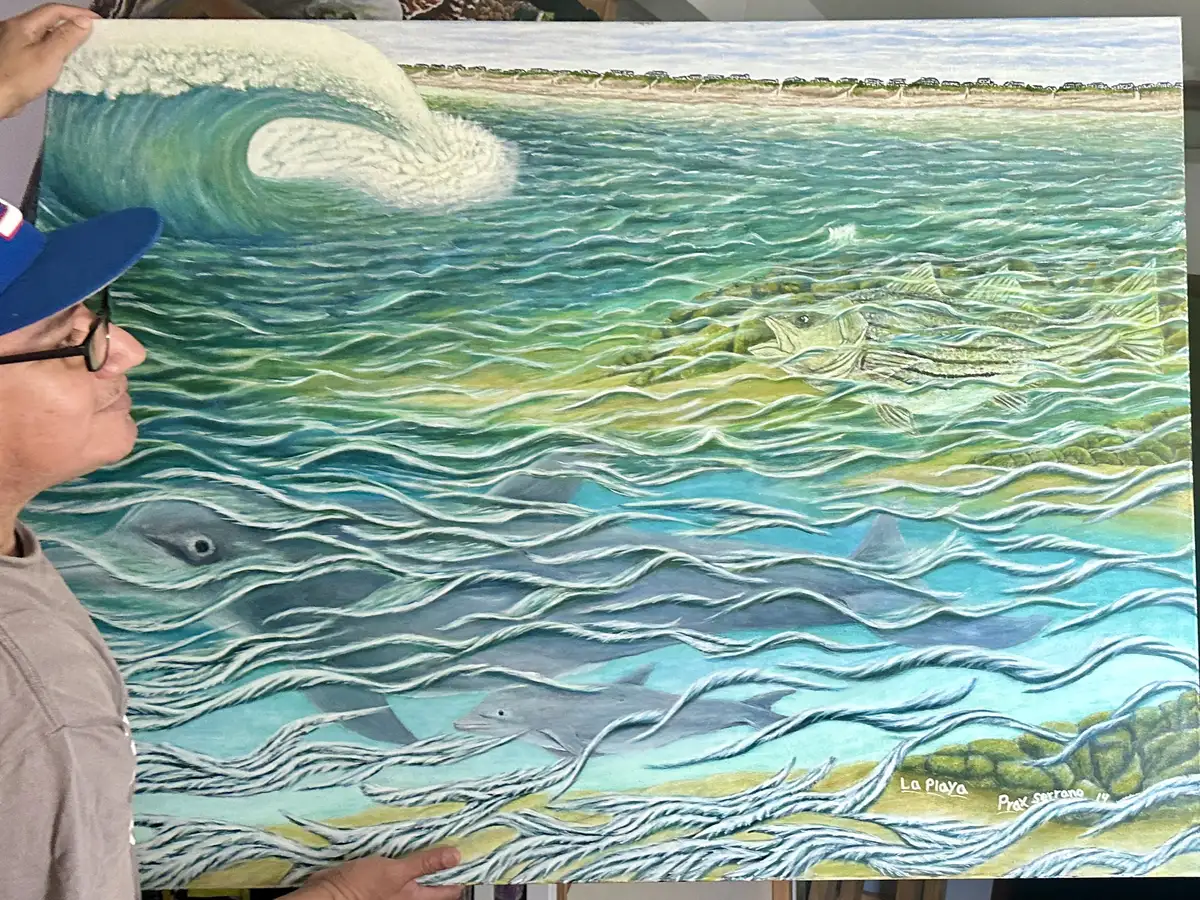
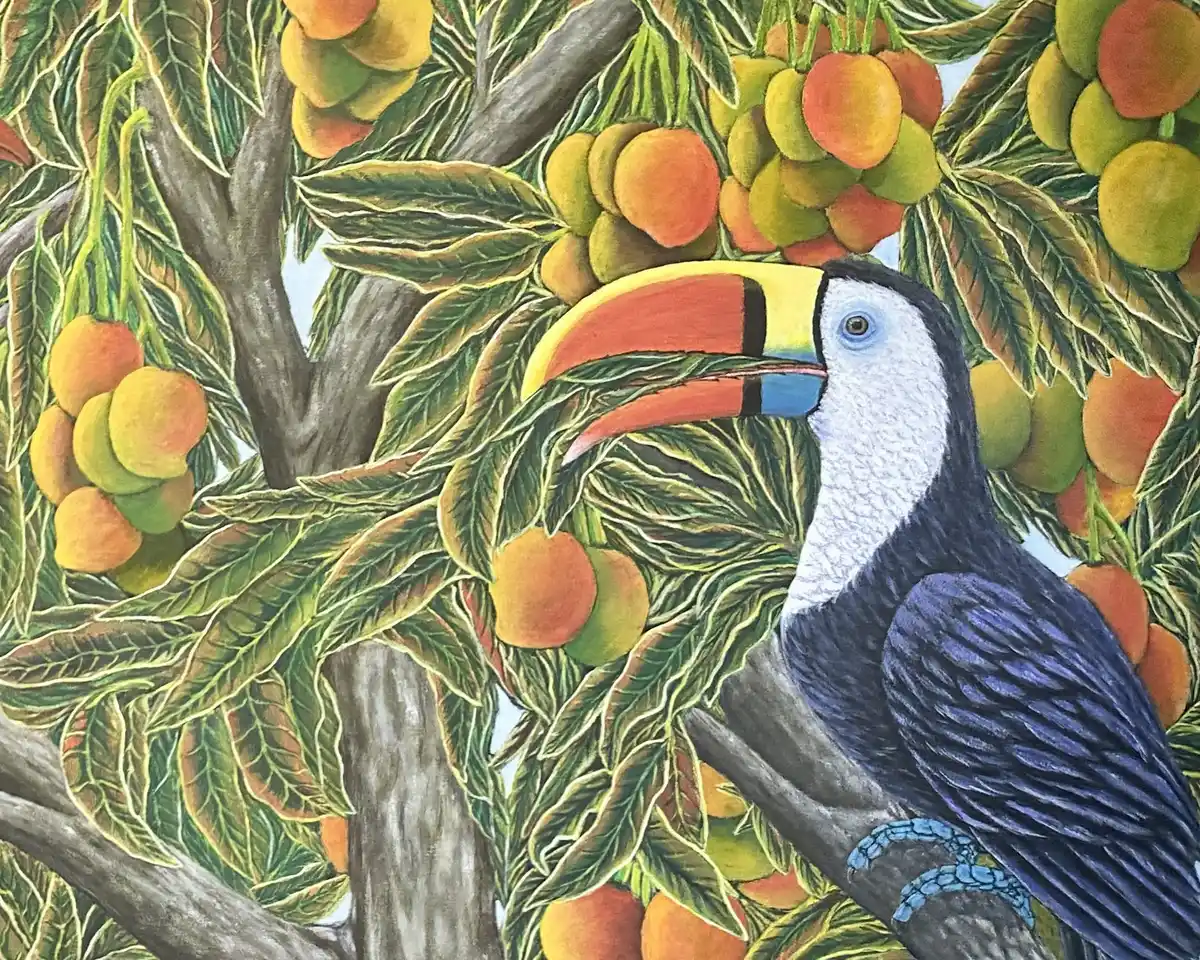
When The SandPaper last caught up with Serrano, he was displaying work at Firefly Gallery in Surf City and at Maristella’s Luncheonette, which is now Joy and Salt, on “the circle” in Ship Bottom. This year he had work hanging at Bageleddi’s in Ship Bottom – paintings of familiar landscapes, local and exotic birds, foliage, sea life, even armadillos.
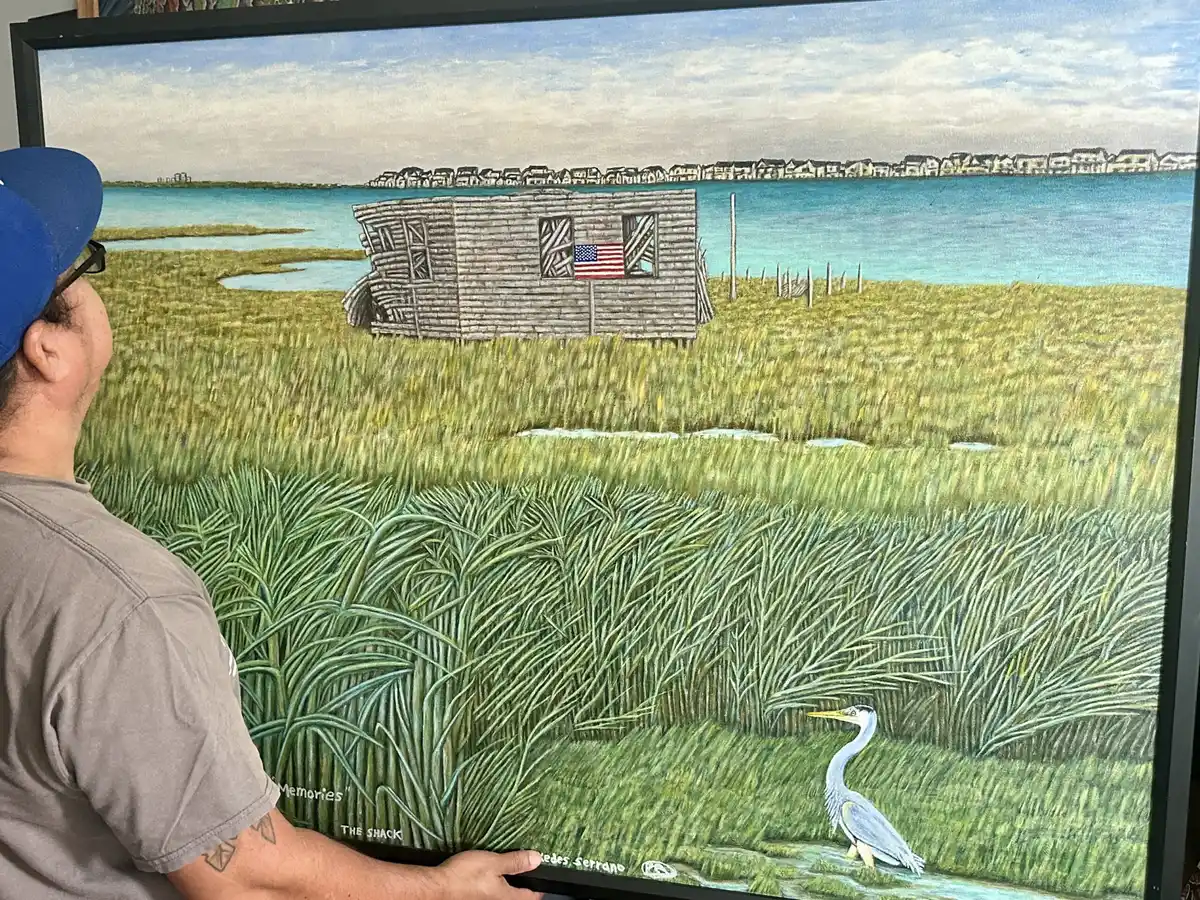
Some of his scenes include local landmarks and legends, such as the Causeway Shack (RIP), and the “Bridge to Nowhere” at the end of Stafford Avenue in Manahawkin.
“I used to go there a lot,” he said. “I just love the view there.”
Born in Oaxaca, Mexico, Serrano came to the United States at age 14 and attended The Cooper Union for the Advancement of Science and Art in New York City, where he learned foundational skills in different mediums. His heart was divided between fine art and filmmaking. He would sit and sketch people in subways. He and his classmates filmed a documentary in Central Park.
“But I just knew I wanted to paint,” he said.
Today, his style is rooted in his personal and cultural experiences, his Catholic faith and his vivid imagination.
Once he discovered Long Beach Island and fell in love with the beach, he couldn’t leave.
He loves the stabilizing flatness of the vast ocean from the vantage point of the top of a dune. “I usually just go there and watch the waves,” he said.
He’s been working in commercial kitchens every summer of his adult life. The off-season brings time for painting.
“That’s when I concentrate more on art,” he said.
When the craziness quiets down and the days shorten, Serrano allows creativity to take hold, filling his nights with paint and music – an important part of his process, he explained, calling it “my energy source.” Sometimes he works until daylight.
“I don’t like to be quiet when I paint,” he said. “I need to have noise. And it concentrates me.”
Inspiration is currently brewing for Serrano in the form of introspection. He has begun working on a self-portrait from his childhood in which one theme is “the struggle” while another is “things that I used to like when I was a kid,” or reconnection with a younger self.
He usually has an idea of the end result when he starts, but the vision might change as he goes, “without losing the same outcome.”
He is also exploring new techniques, he explained, by applying paint abstractly and then building and adding the details to turn it into a picture. He usually draws directly onto the canvas with black paint, he said, often adding words and subliminal messages in the underlayers that get painted over – affirmations, mantras, something positive or encouraging. The effect of his imagery is, after all, uplifting.
But one time the phrase “I work every day” was in the base layer. He painted over it, but the feeling remained.
“You’ve got to concentrate on what you’re doing,” he said. “Because every single detail, to me, is very important. Sometimes one line, if I don’t like one line, I just go over it again.”
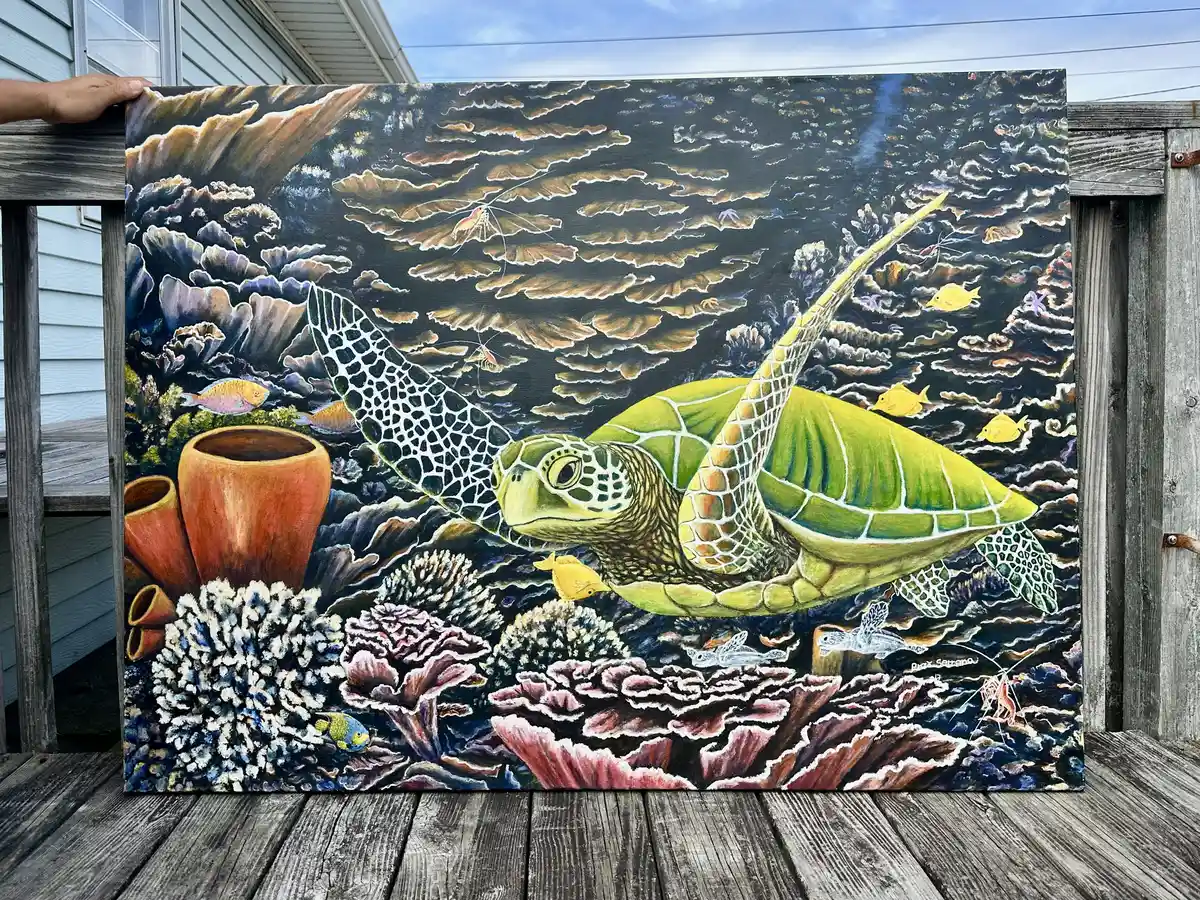
Bold and brave with his brushes, Serrano chooses canvases that are 36 by 48 inches or even 48 square. A few smaller or odd-sized ones were discarded and salvaged. To create depth, he starts with the darkest hues and works toward the light. He gives water a visual current and paints the sides of his canvases for a wraparound effect.
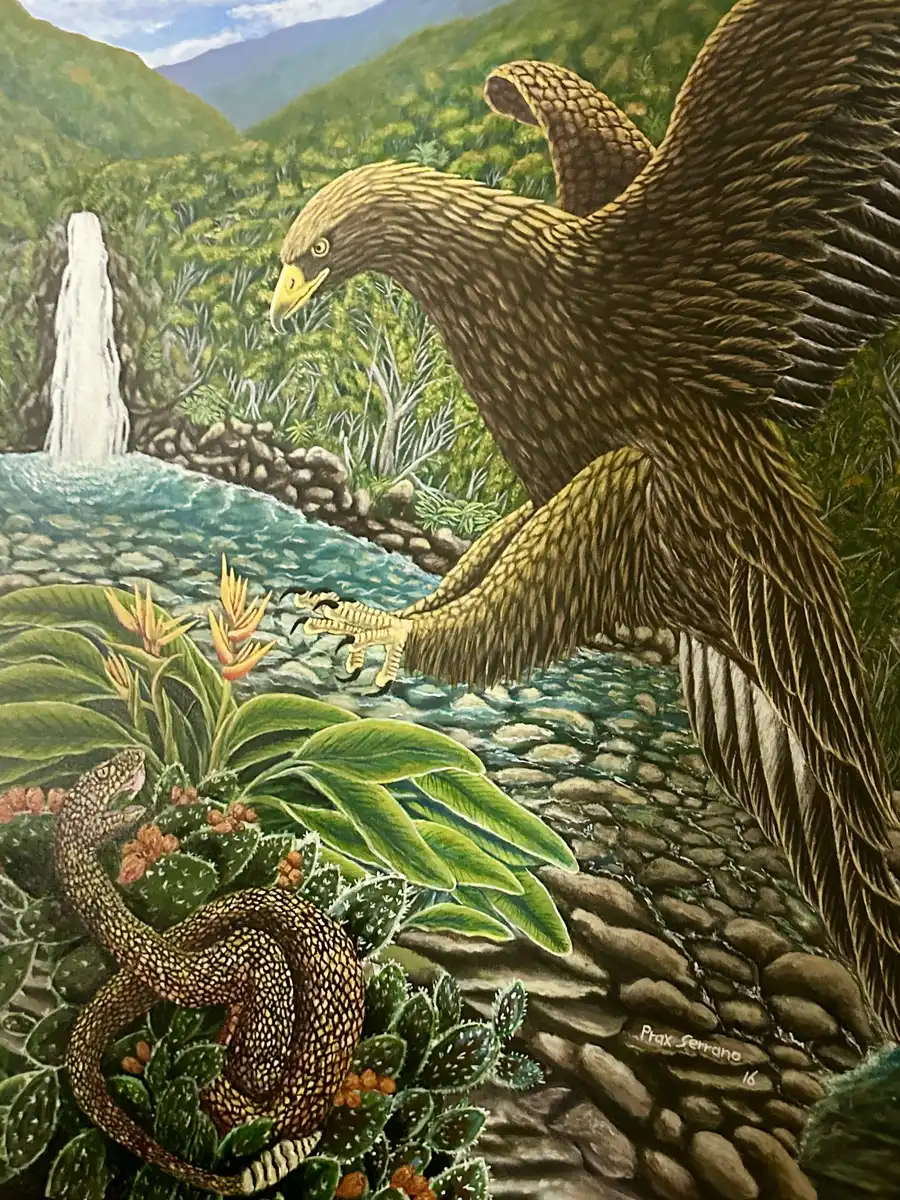
His subject matter ranges from seahorses and brain-like coral to stripers and mangoes; he paints American freedom and values in the form of a bald eagle, and depicts Aztec gods with their sculptures and offerings.
His dedicated art area at home is small, but he doesn’t mind the squeeze. When he’s working, it’s helpful to have his tools within arm’s reach – a comfortable, secure bubble in which he creates a whole world where every decision is in his hands – so long as he can take several steps backward to assess his progress.
When he has exhausted his fuel tank, he rests. The energy to make art ebbs and flows; it can’t be forced.
Look for his work in the wild and find him on Instagram @praxserrano_art.