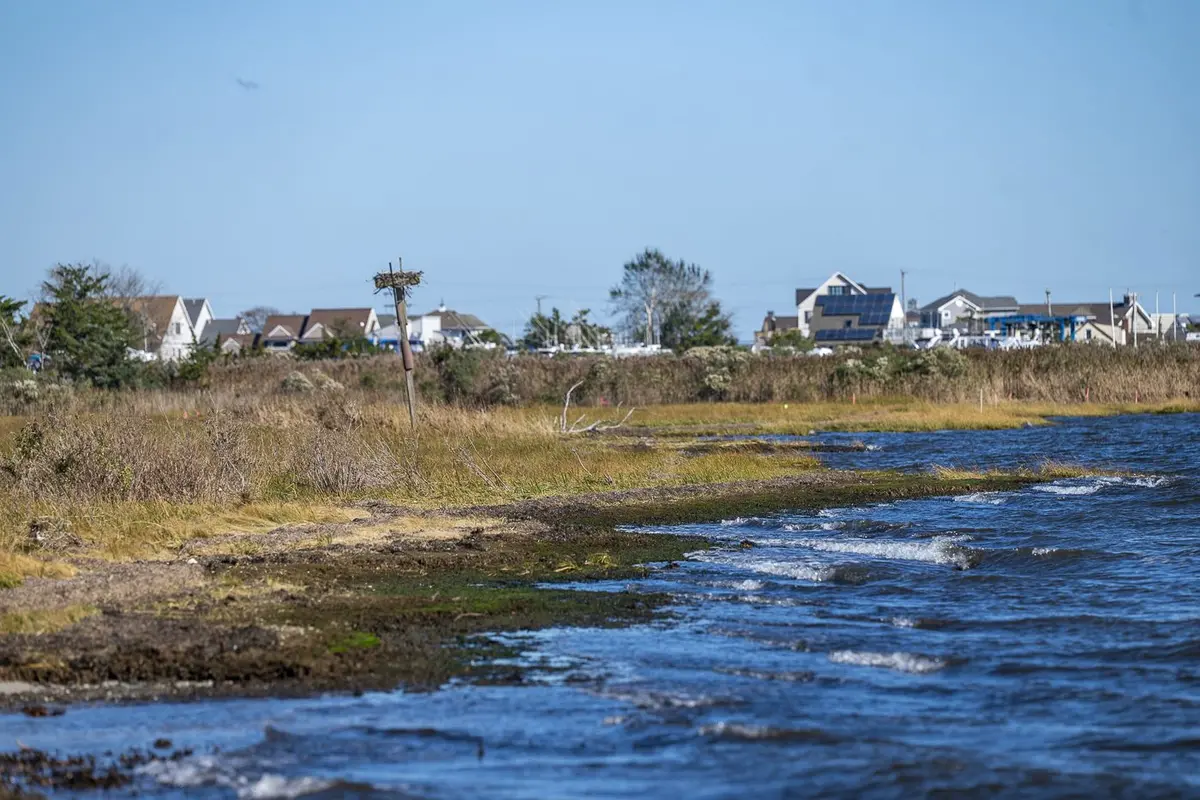
When the right team comes together, dedicated people can tackle big projects. For proof, see efforts currently underway in Waretown to heal and protect a vital coastal ecosystem and demonstrate a marsh restoration program with broader applications.
Spearheaded by the world’s largest environmental nonprofit, The Nature Conservancy, four organizations have assembled a task force of wetlands scientists and coastal engineers to restore a 50-acre tract of coastal salt marsh behind The Lighthouse Center for Natural Resource Education, in the Upper Barnegat Wildlife Management Area. TNC has partnered with the U.S. Fish and Wildlife Coastal Program; the N.J. Department of Environmental Protection’s Fish and Wildlife, which is the land manager under the Bureau of Land Management’s Coastal Program; and the nonprofit Ducks Unlimited. Additional conservation partners are also involved.
The team has worked collaboratively for five years, studying site conditions, developing a holistic restoration plan and obtaining the necessary permits.
The Lighthouse Center is managed by the Natural Resources Education Foundation of New Jersey in partnership with NJDEP since raising the funds to purchase and protect the Lighthouse Center in 2000. The foundation “protects sensitive coastal habitats while maintaining a unique facility for environmental research, education and restoration,” NREF President Dane Ward said.
“As an entirely volunteer-run organization, NREF has been the driving force behind the site’s restoration vision since 2018,” according to Ward.
“What makes this project especially exciting,” he continued, “is its landscape-scale approach, using complementary restoration techniques across four distinct areas to improve the ecological health and resilience of the Lighthouse Center as a whole, rather than addressing individual problems one at a time.”
Hands-on work started the first week of October. The center has become what The Nature Conservancy’s Coastal Projects Manager Adrianna Zito-Livingston called “a restoration hub” and demonstration site, where partnerships and techniques can be developed, scaled up and transferred to other sites.
Assisting in the efforts is the state Department of Transportation’s Office of Maritime Resources, by providing engineering services and dredge material (from its scheduled dredging of three nearby channels next fall) to use sediment from the channel to rebuild marsh where it has been lost, and to re-create a fringing beach to protect the eroding edge, she explained. The sand along the shoreline will form a buffer for the wave energy coming from the bay in the short term and provide passive nourishment for the marsh interior in the long term, as storms wash sand into the low spots.
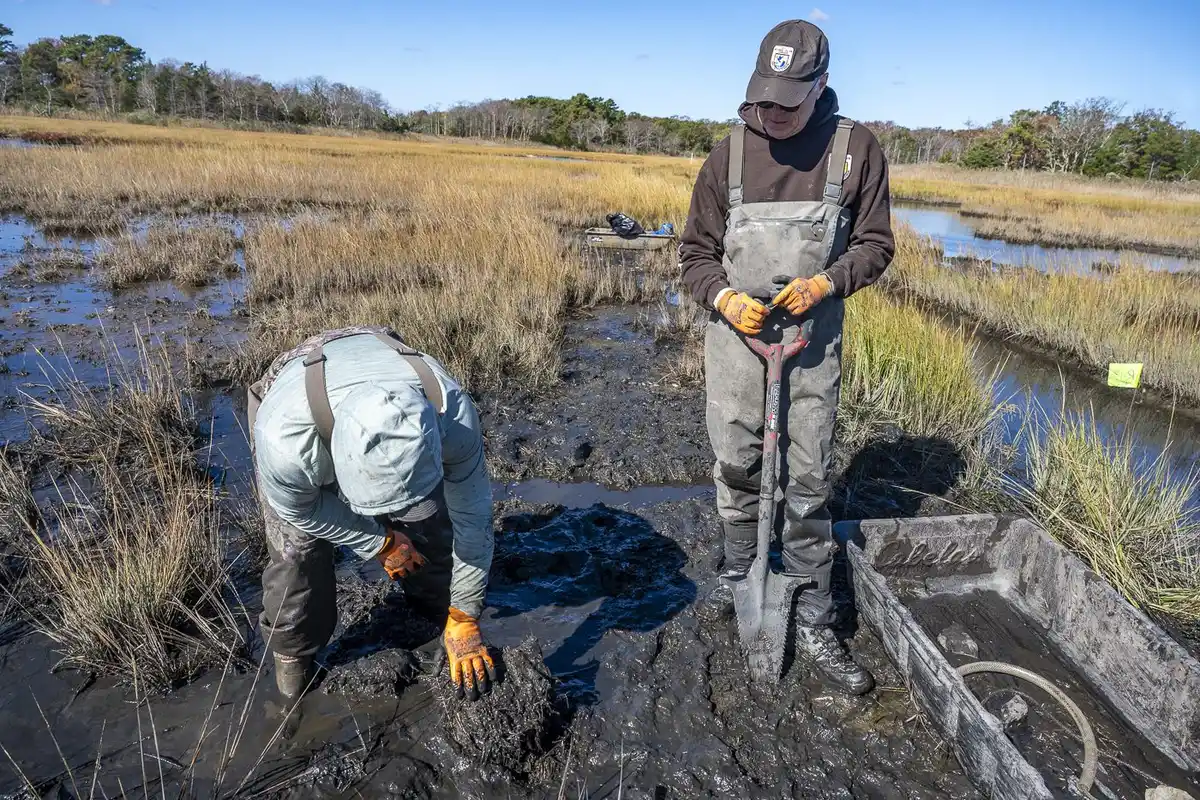
MUD BROTHERS: Colleagues Jim Feaga (left) from NJFW and Brian Marsh from USFWS show how a block of mud cut from a ditch, full of nutrients, is used to support areas where vegetation needs to be reestablished.
Phase one is being led by USFWS and Ducks Unlimited, which are doing the physical wetlands manipulations. Next year, DOT and TNC will lead the sediment placement.
“This marsh is drowning from the interior,” according to Zito-Livingston, meaning “too much water, too often, gets into the marsh interior, and it stays.”
Drowning refers to the process of pools forming in the marsh where water comes in with the tide and can’t properly drain back out. Unchecked, the pools keep expanding until the final result is full conversion to open water. As recently as 20 years ago the edge of the marsh extended 30 feet farther out into the bay, she said.
“This initial phase of restoration is about re-creating healthy tidal connections,” she explained.
The majority of the three-part project area is a 32-acre parcel that still has a lot of its vegetation but has been heavily ditched for mosquito control and diked for salt hay farming.
“A healthy tidal marsh should have one main stem, or channel, and then little fingerlets. So when the tide comes in from the bay, it comes up that main channel and then distributes evenly through the marsh,” Zito-Livingston said.
“Couple of things have happened here. We’ve created linear mosquito channels, so we don’t have a single-channel hydrology – we have lots of water coming in from the bay and staying there. And it leads to the marsh behaving like an overwatered houseplant: When the roots are sitting in water all day long, they aren’t growing properly and, eventually, they die.”
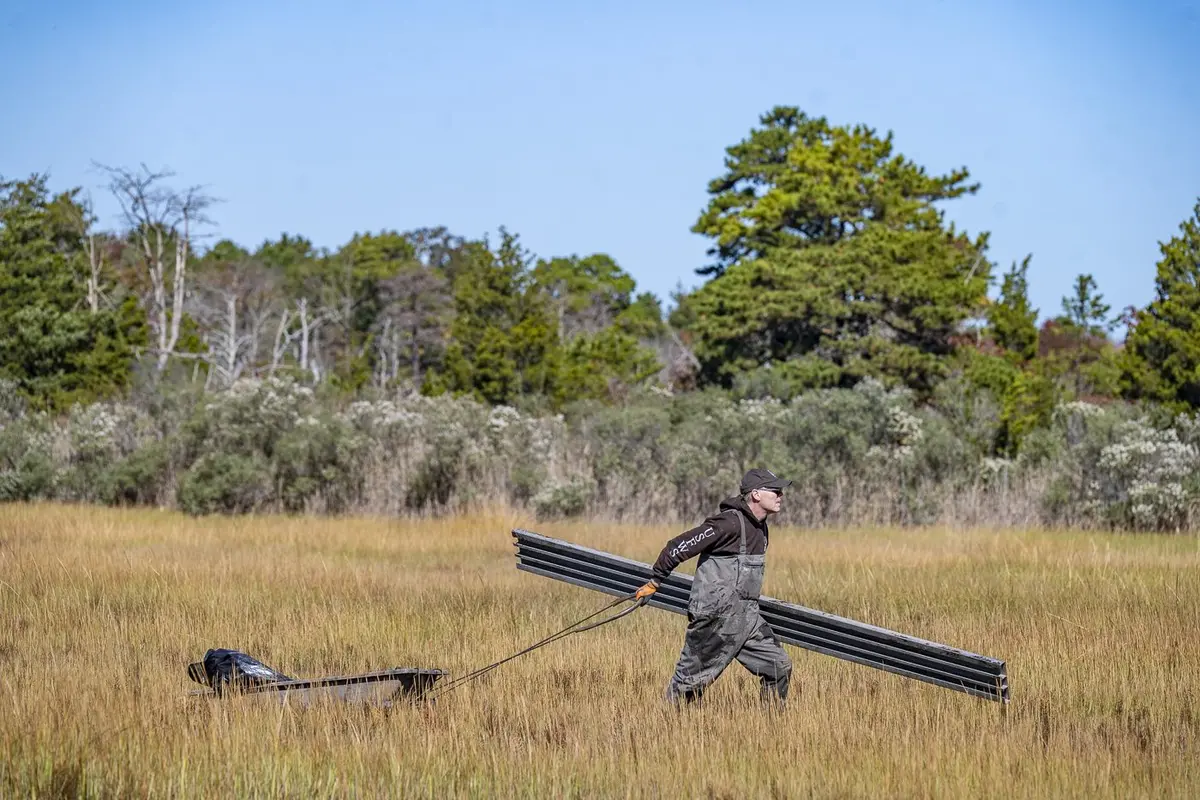
ON A MISSION: USFWS project lead Brian Marsh treks across the marsh plain pulling a sled for ease of earth-moving and carrying a plank for use as a makeshift bridge.
One remediation practice is to plug ditches with hay to restrict the flow of incoming water. Another is to open pathways
for water to drain from the ponds into the main channel by runneling, or creating little rivulets only about a footprint wide and not deep. Tiny flags mark where runnels have been made to connect the pools to the tidal channel.
Going into it, the known problems included edge erosion, converting to open water, and flattening of the marsh. The long-term monitoring data show the heavily researched site has been deteriorating, she said.
Growing near the marsh’s edge are saltwater succulents known as Salicornia or pickleweed, which, while stunning in its autumnal yellow and red, is also a subtle sign of degradation, Zito-Livingston said.
Phase one, in the still-vegetated area, involves lighter-touch, “low-cost, low-tech” tidal reconnection work. Subsequent phases will take place near the neighboring marina, where the sediment placement work will happen.
“We’re throwing all our tools at it,” Zito-Livingston said, to restore ecological function to the salt marsh.
The goal with the sediment is to bring elevation back up to within the healthy growth range of smooth cordgrass (Spartina), the native plant that dominates frequently flooded marsh.
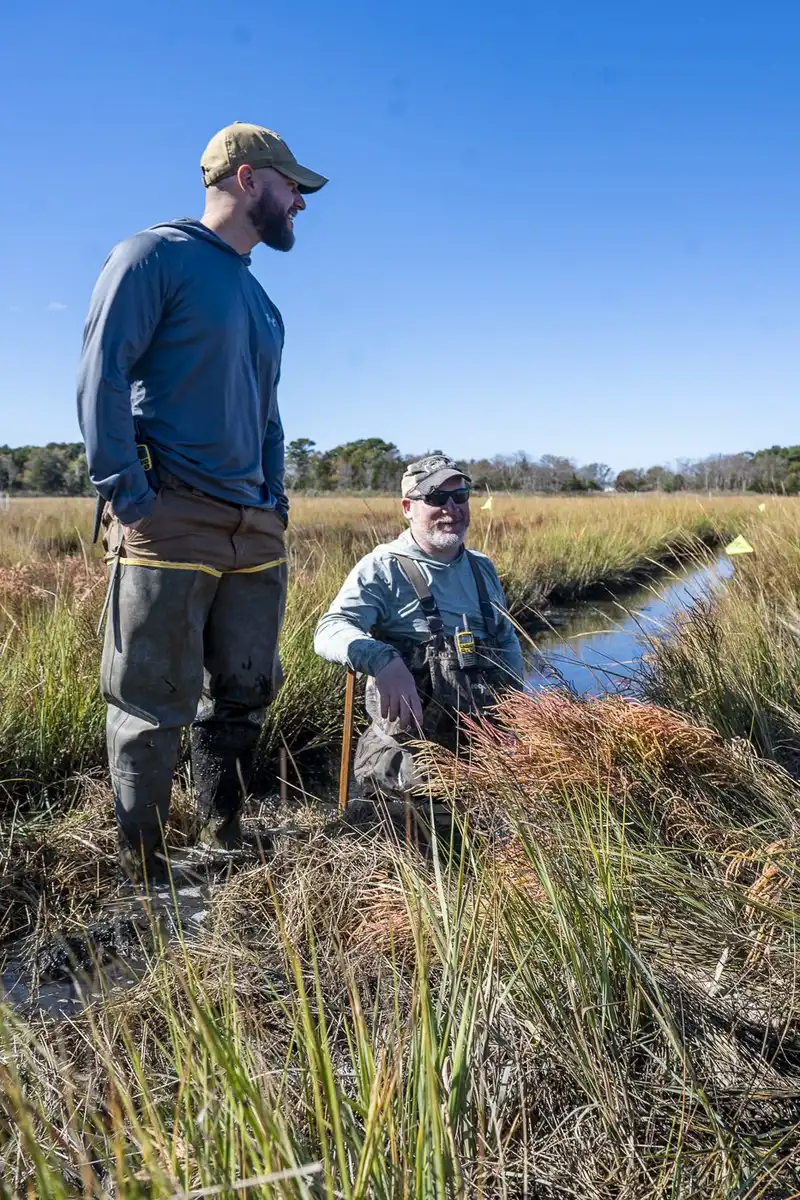
NEW HEIGHTS: Ducks Unlimited’s Ben Langey (left) stands atop the newly installed hay plug, while NJFW’s Jim Feaga is submerged to his hips in the channel, to show the difference in height/depth.
The tidal range at the project site is only 1 foot, which Zito-Livingston described as “very unique to Barnegat Bay.” A wider range means a wider margin of error, she explained, “but here, it’s a little bit more like threading a needle.”
The trick is to keep the plants’ root system at the elevation where they can get alternating periods of flooding and drying out.
“This marsh is losing vegetated area faster than it can support itself,” she said.
With a plant like cordgrass, according to USFWS Delaware Bay Coastal Program manager Brian Marsh, “you see all the growth on the top, but actually, there is five or six times as much underground.”
The massive growth of biomass each year is called biological accretion; the marsh gains elevation due to root production pushing up from underneath. “But that’s only if the marsh is healthy and the grass is growing well,” he said.
Bottom line: Without the marsh, homes and properties are vulnerable. Imagine rolling a marble across a floor, she said. If a mudflat is a hardwood floor, marsh is a shag carpet, providing drag.
“The plants are slowing down the water so whatever arrives in the community doesn’t have as much force and doesn’t travel as far,” Zito-Livingston said.
The work being done will use what is already there to reestablish and expand and let nature take it from there. Annual monitoring of the elevation, plant cover and water levels will help the team determine if additional restoration is needed.
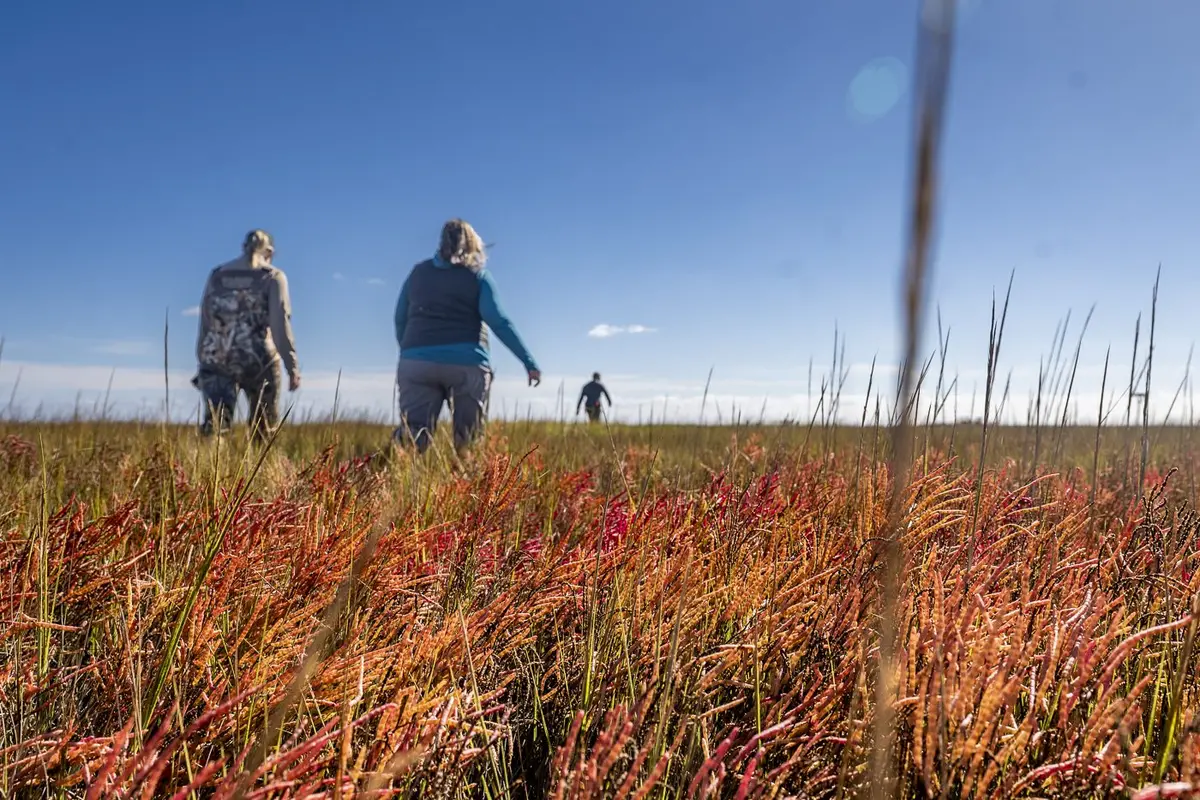
WARNING SIGN: Salicornia or pickleweed (foreground) is pretty, but it means the marsh health is not what it should be.
“You rarely have to replant marshes,” according to Bri Benvenuti, New England/ Atlantic regional biologist with Ducks Unlimited. “You can expedite the process, but, ideally, it fills in on its own, with help.”
Zito-Livingston noted she could already walk more easily in places she couldn’t before they started the first week of work, which had gotten them three-quarters of the way finished.
Still, some leaping is required to avoid puddles.
“That’s the marsh Olympics – you just jump,” Benvenuti advised.
Alas, even the skilled and experienced occasionally find themselves stuck in the muck. The hands-on work is a full-body commitment.
“It’s very humbling out here,” Jim Feaga with N.J. Fish and Wildlife said, “because of the elements, the working environment you’re in. Sometimes you just fall over in the mud and embrace it and just keep going.”
Ben Langey, project manager with Ducks Unlimited, said being ahead of schedule this week would “allow us to do some more experimenting, try some new techniques we discussed in our off week” – such as building habitat mounds, or microtopography islands, using the material they cut out of the ditches, to create some relief and help the marsh re-seed itself.
From there, using hay and other biodegradable materials can help the islands to expand and reconnect; grasses spread across surface rhizomes faster than from seed or plugs, Zito-Livingston said. Grasses’ growth is dictated by the water level around them and the sediment, Langey added.
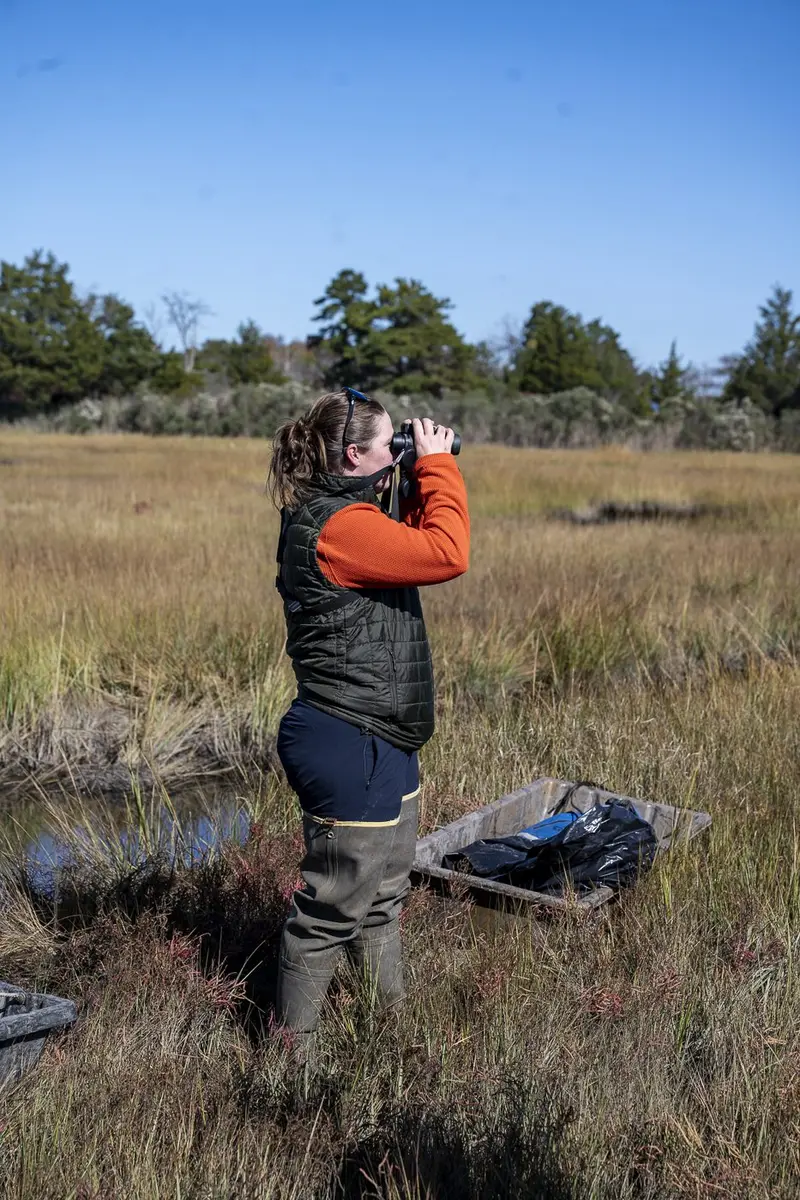
A CLOSER LOOK: Bri Benvenuti, a regional biologist with Ducks Unlimited, visits the site to scope it out. Many people who love the marsh never get to experience it up close, she said.
“We’re just trying to kick-start stuff out here,” he said. “We’re just trying to give it the push that it needs.”
Some ditches need to be cleared out, and some need to be filled in, to create somewhat more of a natural tidal pattern, Feaga explained.
“Marshes naturally do this process as they need to, but there are so many ditches out here, they need a little help,” he said.
Feaga showed how the process brings to the surface some of the muck with seeds in it, to help plants regenerate. “We’re getting nature to do her thing so it can keep going in the long term.”
Langey talked about the success of the hay plugging technique.
“This was a ditch so deep, if you stepped in it, you’d sink up to your hips,” he said. “Now when you step on this, it’s not totally firm up to the top. The idea is you still have flow coming in and depositing a little bit of sediment on top of it. The hay is secured in with stakes and twine so it doesn’t move with the tide.”
There is an art, also, to knowing the right amount of squish – not too soft, not too firm.
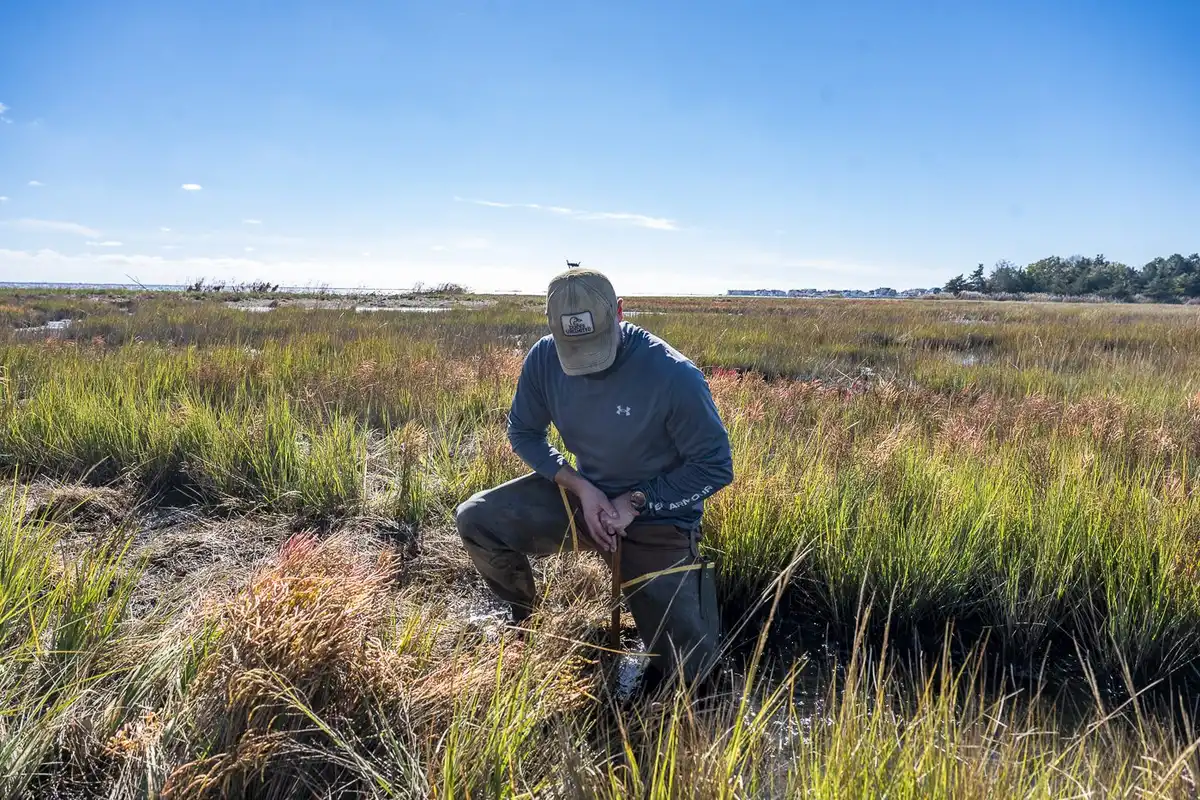
With one foot up on the newly completed hay plug and the other foot down on the channel bottom, Langey demonstrates the height difference. The measure provides immediate relief to the drowning marsh.
(Side note: Hay is delivered out to the work site via air boat, which Zito-Livingston described as a game-changing transportation tool that “flies across the land leaving virtually no trace.”
Places in New Jersey and Massachusetts have examples of pristine marsh; the hallmarks are expansiveness, good drainage and without manmade ditches.
In Tuckerton, down Seven Bridges Road, the “Great Bay Wildlife Management Area is one of the few native marshes we’ve had as an example to go off of,” Feaga noted.
Zito-Livingston summed up, “Working with natural processes seems to be the key, and I think the more we understand these systems and compare effective examples, we can bring them into different geographies. This is also the first microtidal marsh a lot of us have worked in, so that brings its own challenges and opportunities.”
Many of the workers wearing waders and wielding shovels are volunteers.
“It’s people protecting places that they love,” Benvenuti said. “Most people look at marshes from the edges; they don’t get to come out here. These projects are a great way to get people out, in the mud, learning about why the marshes are so important and where they’re going.”
Notice, for example, the PVC pipes that are part of long-term monitoring. Twice a year the amount of change at the surface is measured in millimeters. A long-term monitoring network has a central database for sites across the state.
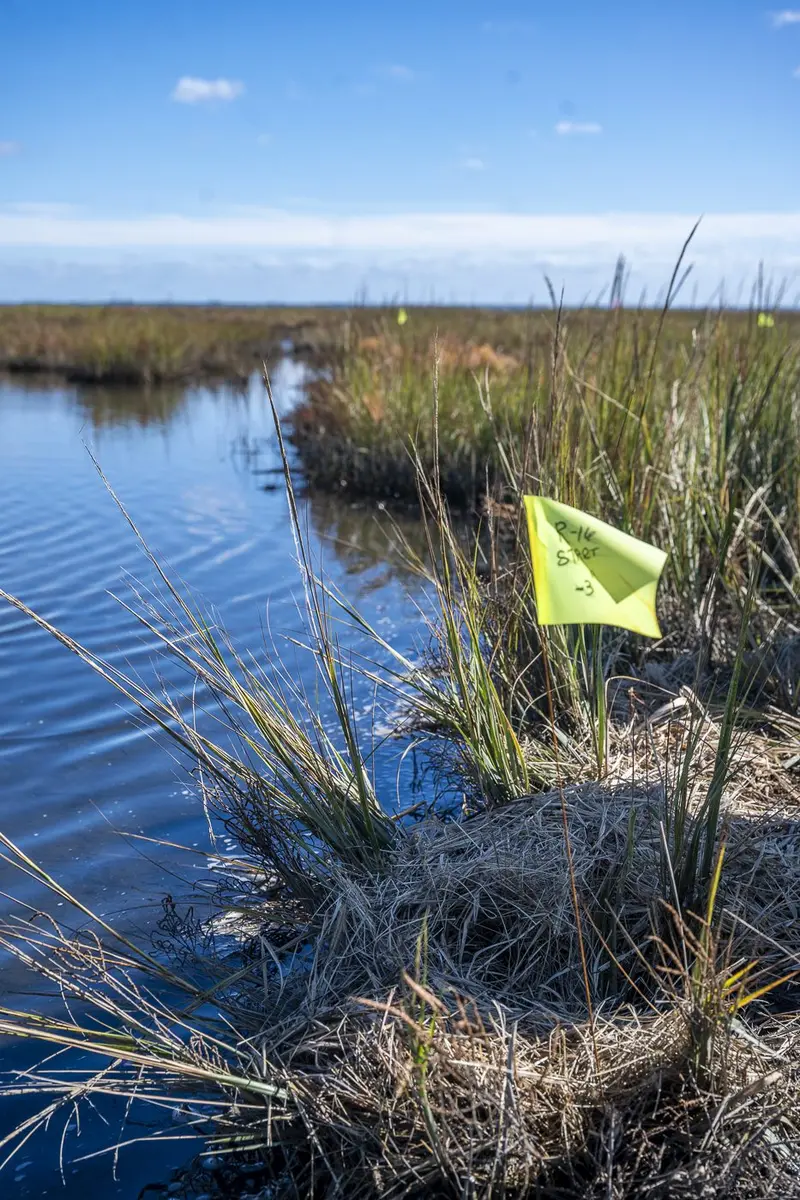
CREATIVE OUTLET: A manmade runnel enters the main tidal channel. Redirecting the flow will help the water distribute more evenly across the marsh landscape.
Improving marsh health is to the benefit of all who enjoy hunting, recreation, supporting important wildlife and coastal community resilience.
Funding for planning of this project was initiated through a $138,000 federal Emergency Coastal Resilience grant managed by Ducks Unlimited, and TNC got a $1.8 million Natural Climate Solutions grant from the DEP Office of Climate Resilience for final design, permitting and “low-cost, low-tech” implementation. The dredging and sediment placement are funded through grant and capital funds from the DOT.
TNC focuses on “matchmaking,” Zito-Livingston said – figuring out how to bring industries together “so we can leverage conservation and transportation dollars to get big projects done more efficiently.”
“Restoration doesn’t end when the contractors leave,” Ward said. “NREF will continue managing these habitats, monitoring ecological changes and working with our partners to adapt restoration practices as sea levels rise and coastal storms intensify. We envision the Lighthouse Center as a living laboratory and training ground where scientists, students, restoration practitioners and community members can learn from both the successes and challenges of coastal restoration.”
According to Ward, New Jersey needs more people equipped to address the accelerating loss of coastal habitats. The hope is the lessons learned at the center will help build capacity throughout the state and beyond.
“None of this would be possible without our dedicated volunteers, and we’re always looking for engaged community members and prospective board members who share our passion for Barnegat Bay,” he said.
The public is invited to the Lighthouse Center Dec. 5, from 10 a.m. to 1 p.m., to learn more about the project and how to get involved.