With hunting season moving in, I want to highlight our area’s most famed outdoorsman, someone every single one of us has heard about, somewhat unknowingly.
Back in pre-Revolution NJ times, there was a burly stump-jumper named Thomas Lovelady living in Waretown, a community that epitomized an early backbay town. Records list Lovelady as one of the “first whites” to move into the vicinity, circa early 1700s.
By the by, “stump-jumper” is an olden expression first used by early Long Beach Islanders. It referred to mainland folks living on the swampy mainland side of Barnegat Bay. Pineys lived a bit farther inland.
Out of time period necessity, Lovelady was an occupational hunter, clammer and fisherman. He also possessed a sharp business acumen.
During his constant Barnegat Bay jaunts, he took notice of a mighty fine-lookin’ 10-acre sedge “over yonder, toward the island,” meaning Long Beach Island. LBI’s longer name was seldomly used back then.
For the equivalent of a couple bushels of clams and a few neck-wrung ducks, he purchased the meadowy piece of real estate, making it into a convenient base for his hunting and bayman activities. Upon it, he built a sturdy, albeit piecemeal cedar shack.
Over time, Lovelady’s businessman side kicked in. He foresaw his unnamed island becoming a hunting attraction, drawing in “rich city folk,” mainly sportsmen who had begun swarming to Barnegat Bay to partake of its remarkable gamebird population.
It worked.
Upgrading his shack, he was soon entertaining wealthy overnighters seeking the whole bay hunting experience.
The rugged venue was soon referred to – and advertised as – “the Lovelady shack,” or simply “Lovelady’s.” It would remain a sportsmen attraction well into the 1800s, carried on by family members after Thomas passed.
The salt marsh shack offered minimal amenities, short of a wood-burning stove, fold-down beds with mattresses stuffed with salt hay and a well-maintained firewood stack. Nearby were well-crafted hunting blinds.
Customers needed to bring their own food and drink, though always having the option of spending nights in the relative luxury of Waretown, albeit a trying row out to the sedge, especially during storms and high winds.
Over the decades, there was very little change for the area around Lovelady’s. Then, in 1871, “U.S. Life-Saving Service Station Number 114” was established nearby.
Located on Long Beach Island, the station was an expansion of the maritime rescue system along the New Jersey coast.
The facility’s surfmen and their family members took an immediate liking to their new home but disliked its stodgy government name. Within a decade or so, the station was nicknamed “Lovelady’s,” roundaboutly honoring the famed Waretown outdoorsman, though more so his shack.
It’s hard to accurately pin down when the name made the grammatical tweak from “Lovelady’s” to “Loveladies.” Confusing matters, records indicate there was a stint when the area was colloquially referred to as “the clubhouse,” possibly alluding to the shack, though also covering a prominent local gunning club.
During WWII, the area was governmentally designated as “Long Beach Park,” possibly named by Long Beach Township, which was incorporated in 1899, and included various small communities on Long Beach Island, including Loveladies.
Postwar, it was determined that Long Beach Park sounded too much like other Island towns using various forms of “Long Beach.”
Finally, in 1952, it got its current and likely forever Loveladies name.
As to Loveladies’ switch to rich, loveladies.org/board writes, “Most of the homes here were destroyed in the catastrophic storm of 1962, and the rebuilding effort produced a vast array of modern homes noted for innovative architecture and design.”
The rest of the Loveladies real estate tale is currently on display via homes going for a median price of $4.4 million to $4.6 million. This past September saw an oceanfront “estate” selling for $11.55 million.
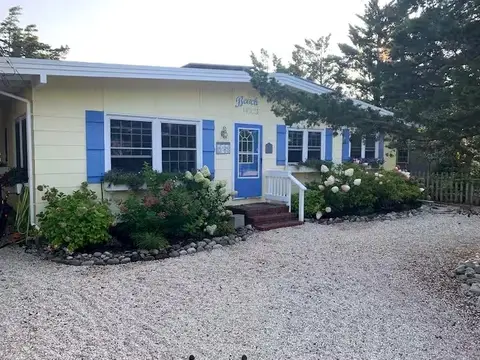
With those prices in play, there’s a profound historic irony that the community is essentially named after … a decrepit shack.
BACKBAY TALE: While recently re-acquainting myself with Barnegat Bay history, I came across a twice-told baymen’s tale dating back to the early 1800s. It tells of a rich “gunner” (hunter) and his “fierce bulldog” stopping by a local bayside tavern.
Noticing the chain-collared fighting dog, the tavern owner quickly warned the hunter to keep the dog away from the tavern’s backyard area, where he was nursing a wounded loon.
The warning took on an odd turn when the innkeeper, while serving a tankard of beer to the hunter, nonchalantly explained that he wasn’t concerned about the loon; instead, he feared “the loon might hurt the dog.”
Such a seemingly daft notion got a solid guffaw from the gunner. Then, as the ale kicked in, he also began to get ticked off.
By the draining of the second tankard, the hunter was fully irked. Slamming down his drink, he loudly challenged the tavern owner, betting $25 that his 50-pound bulldog would make mincemeat of the bird. That was major money for the times.
Attracted to the amount, the proprietor grudgingly accepted the wager, needing to empty his till to cover it.
Within the tavern, side bets quickly began flying freely, soon covering the bar top.
The hunter confidently covered all bets, though a bit confused as to why so many patrons were backing the loon.
Bets laid, it was showtime.
Firing up his dog, the hunter led the snarling canine around back, unloosing it into the loon zone, shouting “Sic ’em!”
By all accounts, it was a nasty battle, albeit short-lived.
As one written account has it, “In an instant, the loon pecked the dog’s eyes by suddenly darting his sharp bill in quick succession.”
Howling in pain and surprise, the dumbfounded bulldog hastily blinked its way out of the yard, after which the frustrated hunter collared it and stormed off, the dog “bouncing off of things.”
The only aftermath was the loon later being released … “in fine fiddle.”
BIGFOOT AMONG US: The matter of Bigfoot came up in a fascinating phone call last week. I’ll eventually get into the backstory – after an interview or two.
I’m among many who esoterically wonder if Bigfoot might be an interdimensional traveler, a creature that happened upon a cosmic wormhole – a time warp tunnel connecting our realm and its home dimension.
Wormhole tunnel travel, as theorized by Albert Einstein and Stephen Hawking, might explain Bigfoot’s perplexing and speedy comings and goings.
Such parallel-universe travel might also offer insights into why Bigfoot photo images are almost always unclear, conceivably the result of unsteady interdimensional transitions. Or, in the words of comedian Mitch Hedberg, “Bigfoot is blurry; that’s the problem. It’s not the photographer’s fault. Bigfoot is blurry, and that’s extra scary to me. There’s a large, out-of-focus monster roaming the countryside.”
Yes, we have Bigfoot sightings aplenty in our N.J. countryside.
The Bigfoot Field Researchers Organization lists nearly 80 “official” reports from across the state. Burlington County (16 reports) and Ocean County (11 reports) are apparently highly popular with large-footed Sasquatchian sorts.
Reports from the Garden State are doubly telling since we’re the most people-packed state in the nation. We also have the nation’s highest hunting contingent per acre. Combined, we offer the greatest per capita likelihood of grabbing a good look at a manifesting Bigfoot.
There’s also the eerie multiverse possibility that the state has a significant scattering of functioning wormholes, especially in the Pines. Be mindful of that when hiking around. Should you fall into one of those suckers, you could end up in a dimension chockful of Bigfoots – many of them frantically trying to get a money shot of a “Littlefoot” in the distance.
WEATHER WORD: Last week, when speaking of an increasingly wonky polar vortex, I conveniently failed to explore an icy side of what might happen when that arctic system fails to do its sworn duty of containing icy air to our north.
I was alerted to my non-mentioning by a meteorologist buddy.
A skier, he took joy in reminding me that the last serious weakenings of the stratospheric polar vortex allowed the lower-down tropospheric polar jet streams to push bitter blasts of record coldness into parts of North America.
I’m still banking on the overall atmospheric confusion born of the Super El Niño to muscle out any potential icy “spills” by allowing warm southerly air flows to dominate our coastal sector of the nation.
Fox News encapsulates the upper air conflict, offering, “North America’s jet stream pattern this winter (2026–2027) will be driven by a rare tug-of-war between a Super El Niño and an unprecedented early polar vortex disruption.”
The current and wonderfully lengthy batch of exceptional fall weather is not tell-tale. We’ll get wind of polar vortex frigidity or Niño-ized mildness by mid-December, though more so by January.
TOG-NADO: There have been some tog-athons along the South Jetty in B.L. I witnessed rock-top anglers taking small tog at a one-a-minute rate. I stood by as one walkway regular needed only 25 seconds to cast, hook and pull out a 10-incher.
Keep in mind that those tautog-hooking flurries are highly intermittent, mainly based on tides.
I won’t venture a guess at the keeper rate, except to say it is wearily wanting. A top caster lost track of his catch count with nary a take-home for days.
Speaking of take-home meat, and passing along a warning, it’s well known that an angler can keep only one legal (15-inch +) blackfish a day – until Nov. 15, when it goes up to a five-fish bag limit.
The one-a-day bag does not mean the luckier angler in a group or family unit can catch a keeper for others. Fish and Wildlife officers watch for that.
As to the reason for such a fabulous concentration of tautog in the inlet area, I stick with my belief that the sanding-under of the Island’s groins removed hundreds of prime Island habitat areas. Thousands of blackfish lost their favorite fall hangouts. All that remain for miles on end are the inlet jetties.
Back when, many an Island surfcaster would grab a quick break from catching bluefish and stripers to sidle up to any jetty. Casting out freshly dug sand crabs on a 1.0 blackfish hook, it was easy to grab a meal’s worth of tog.
I’ll cautiously suggest that blackfish biomass might be a conservation success story, though ongoingly hampered by those professional poachers.
Just as negatively impactful are simple everyday over-grabbers. These are common folk who routinely dare to tuck away an extra tog or two – always ready to theatrically swear they didn’t know the regs. When tallied, their combined catches can match the take of career poachers.
Pass-along chuckle: A violator caught keeping a few too many tog told an officer she didn’t know the rules. The officer then pointed out a large nearby placard displaying said rules. She swore she could not read English. Then, when given a citation, she looked at it and quickly asked what it meant that she could pay online or by mail. Oops.
RUNDOWN: A mini alert for cows grazing the east 20, meaning our beachline.
I’ve seen four different reports of major bass being taken by the scant few surfcasters tossing out larger bunker chunks and such. Based on social media pics, these trophy fish are easily pushing 40 pounds.
Understand it’s nothing close to surf-fire stripering, but we might be into the year’s finest showing of what we used to improperly call “Bubbas.” Obviously, it’s the gals that have the greatest length and girth.
Boat bassing is further proving a large biomass of bass has sauntered into our waters. It’s the slow arrival – better late, etc. – of migrating bass from the north. They could linger if forage is plentiful. The fatness of the current hookups suggests they’re into some fine vittles.
Next week, I’ll finally cover freezing a whole bass for the holiday.