Along with the latest digital tools that make mural painting more accessible, themes of morality and ethics have entered the chat surrounding how art is made. Dan Koval, founder and creative director of Koval Murals, is one artist who isn’t shying away from the conversation.
“When it comes to commercial, brand-driven work, we’re here to solve a client’s creative problem,” he said, “and we have no problem using technology in the work.”
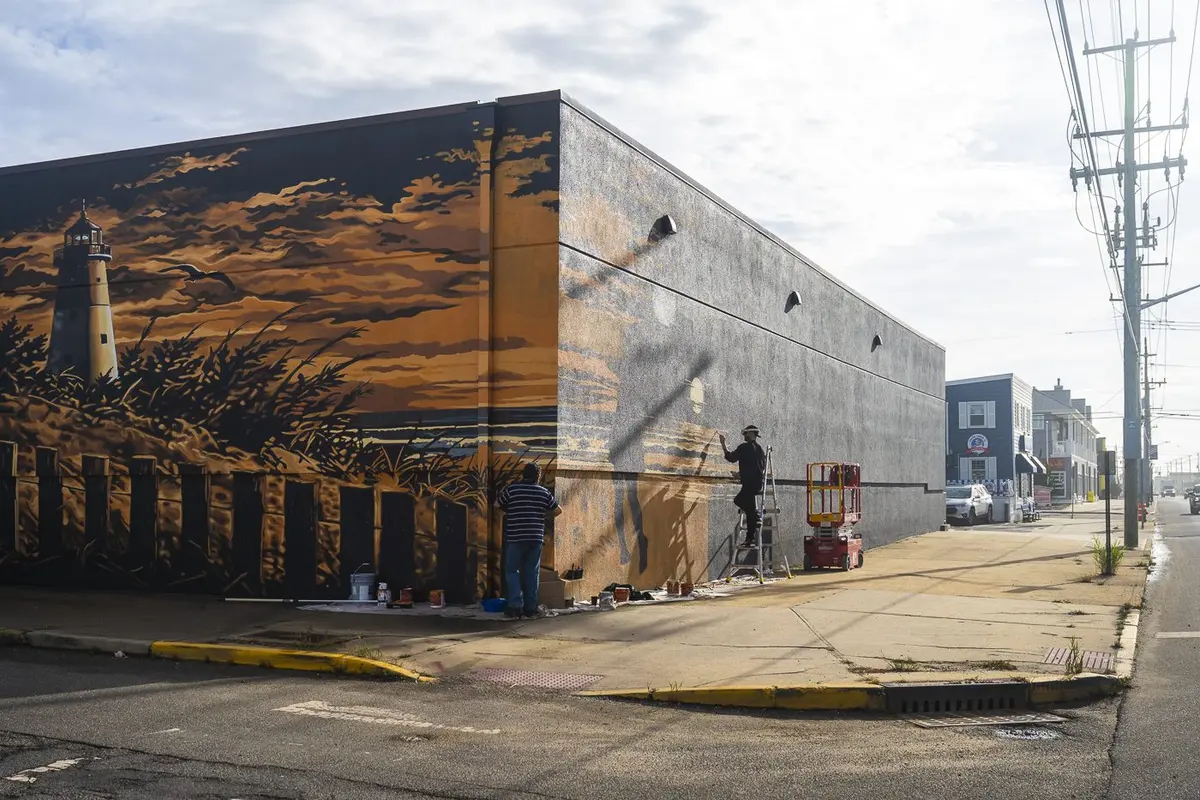
He and a small crew of artists have spent weeks transforming the exterior of the 8,500-square-foot former Dollar General building in Ship Bottom from drab brown into a vibrant, modern scene of the Barnegat Lighthouse and a golfer practicing her swing as the sun comes up (or goes down?) over the water. The vista will serve as a brand identity for Shot Shaver LBI, a year-round indoor golf simulation club cofounded by Christine Mundy, who also owns Dockside Diner in North Beach Haven and has a vacation rental business.
Before Koval started, the whole building was primed with black LOX-ON masonry paint.
“The inside, we’re going to do more avant-garde, take more risks,” he said.
On the job site one recent blustery November day, Koval showed how the tried-and-true projector method of transferring a design to a surface is fast becoming a thing of the past, as newer, more efficient production methods come along.
The Lambertville-based mural maker incorporates a Meta Quest virtual reality headset into his business practices and uses the application SketchAR (augmented reality) to lay digital imagery over his real-world view.
“Every muralist has one of these things,” he said. “This is the new standard.”
Used with transparency and integrity, the technological tools benefit everyone, he said, describing himself as “super outspoken” about the topic. The end result, he said, is a happy client and a high-impact visual impression on passersby.
As the self-affirmed voice for artists who want to overcome the stigma associated with making art for profit, Koval is proud to provide a service.
“This building was a huge eyesore,” he said.
“I’ve never seen a town so happy to put a mural up,” he added. “I’m very thankful for the people of LBI.”
Because Koval is also a partner in the Shot Shaver franchise, he cares all the more deeply.
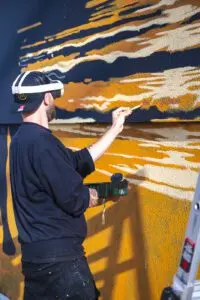
A Meta headset (above) shows the wearer an overlay of the design so they can paint with precision. (Photo by Ryan Morrill)
His “emerging artists” program, which can help schools secure funding for art education, will bring local students onto the job and give them hands-on training experience.
“I want as many people to take ownership of the work as possible,” he said. Getting the community involved creates a buzz, keeps it fun and makes a broader impact.
Mundy “had a strong vision” for the mural she had in mind, Koval said. The main objective was to alter the northwest corner of the building visually so it appears to recede.
“If this is done right, it will be a really cool illusion from that (traffic) light right there that looks amazing,” he said.
The Shot Shaver job is his biggest to date. Previously his largest mural was a 150-foot wall in Woodbridge Township.
Once finalized, a project design is loaded into the AR program and displayed on the wall with the lenses when the wearer looks through them. With two handheld controllers, he can adjust opacity, size, crop and more.
“This is a game changer,” Koval said of the headset. “We used to have to wait till the sun went down, go across the street, throw it on a projector, and come back in the morning (to paint).”
After high school, Koval’s artistic talent landed him in the tattoo business, where he learned how to put personal expression aside to fulfill clients’ orders. It’s still his modus operandi.
“There is a commercial element to what I do,” he said. “Maybe I am more of a craftsman than an artist.”
His very first mural was in his nephew’s nursery.
“Right there I made a decision, and I’ve just never stopped painting,” he said.
Then he did a Cat in the Hat at a daycare in 2016. In the 11 years since, he’s lost track of the number of murals he’s completed.
Each project starts with a site visit. Permissions may need to be obtained. Then the idea gets drawn up on a computer to be communicated visually. With the help of artificial intelligence, he said, the end result is “larger, done faster, done nicer – it really expands your creative boundaries.”
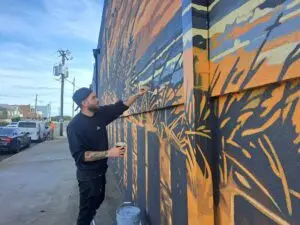
“We’ll generate something, and then we’ll go in – as graphic designers that work for my company and me, hand-drawing stuff (in Procreate) – and we really expand on it. So we make a fusion of AI technology, human technology and what we can do with the Meta glasses to enlarge images.”
With a design mapped out and color palette selected, Koval can sub out the painting part to expedite the process. Stepping back to be more of a director will let him scale his business nationwide.
“I will always control the vision,” he said. “I’m always hands-on in every project. But we want to make this type of work more accessible to business owners, townships and everyone.”
About a year ago he started relying more heavily on the headset, “but the technology wasn’t perfect (then) like it is now,” he said. “The app has kept improving, and every time you update it, the image stays more still, it can get larger, less blurry, and it’s just become really, really helpful.”
“These programs are becoming so developed, they are becoming legitimate artistic tools,” he said.
In forming a judgment about AI-generated artwork, he said, context is key. Issues of ethics arise when an artist tries to pass off AI art as original. But while a prompt such as “make me a golf mural that looks nice” might yield a half-decent result, it won’t help his business grow.
The average person might not even care to know the difference between a human- and AI-generated product, but “the future belongs to those who can prompt their AI really well,” he said.
Currently Koval is building a permanent in-house team of artists he rotates in and out for certain jobs. Some of the more entrepreneurial ones he mentors, in preparation to send them out on their own.
(“I always wanted to grow a ‘house,’” he said, as distinguished from the “agency” stigma. “I’m interested in retaining only very good talent.”)
Koval’s work can be seen in a Mexican restaurant in East Brunswick, at Sinners Steakhouse in Point Pleasant and Kenilworth, and in all U.S. locations of a Copenhagen-based menswear line called Lindbergh, in New Jersey, Miami, Atlanta and Las Vegas.
“I’m passionate about my customer, and I do love the business side of it,” he said.