Somewhat a-cringe, I recently listened in on a conversation about the days of eating robins. The breast meat of a hapless robin red breast is apparently suitably edible, if you’re into that sort of small-bite thing.
It was long ago but not far away that hereabouts folks would attract robins to the yard with sprinkled seed – to then blast them to birdie heaven. After the feathery fallout from a double-barrel blast had settled, DOA birds would be gathered, cleaned and fried in an iron skillet. I heard tell about an ounce of eat-meat came off every bird.
As to what robins taste like, they pretty much taste just like robins. It then so happens, in turn, chickens taste just like robins, a pecking-order taste distinction robins find rather important.
Our area’s robin-roastin’ days were profoundly different times, which came down to feeding one’s self and family when clamming and fishing were on a winter hiatus. Once heard: “Oh, Mom, not robins again.”
Was robin shooting legal? Nah. But nary a ticket was given for robin poaching, even though it was in stark violation of the federal Migratory Bird Treaty Act of 1918 (MBTA), a law still applied today – though possibly soon to be weakened.
For some of you fastidious bird folks, a case can be made that robins are, in fact, non-migratory. Nonetheless, the MBTA has honored these most-American members of the thrush family with can’t-shoot status.
The days of front-yard defiance of the Migratory Bird Act have pretty much flown the coop, spooked off by our area’s rampant buildout, along with an enrichment of the local demographic. That’s a coy way of saying richer times and even richer residents have nested here. Ye olden robin-frying locals, unable to stomach all the changes, have taken flight themselves.
Surely for the better, virtually all birdfeeder birds are now strictly protected via the Migratory Bird Treaty Act. The act has also long been used to ban – or punish – activities that kill songbirds, or even gamebirds, in a secondary or collateral-damage manner. That interpretation is now under fire through White House windows.
ASSAULT ON MBTA: In an article titled “Administration Moves to Weaken Migratory Bird Safeguards – Proposed rule would end decades of protections for migratory birds,” The Nature Conservancy writes, “The proposed rule would codify a controversial legal opinion issued by the Department of the Interior in 2017 declaring the act does not prohibit unintentional killing of birds.”
Lynn Scarlett, chief external affairs officer at The Nature Conservancy, said, “For more than a century, the Migratory Bird Treaty Act has been the shield against the extinction of over 1,000 species of birds in North America.”
An example of the act’s power and prowess was seen when ExxonMobil was caged by the Migratory Bird Treaty Act, found guilty of “failing to protect” 85 birds from essentially drowning in open oil tanks and pits. The mega-company was fined $600,000 and forced to spend $2.5 million to modify oil facilities.
In essence, the proposed interpretative ruling of the MBTA by the Department of the Interior would greatly ease restrictions applied to oil exploration, wind power, land development and even the building of factories.
Efforts to fight the weakening of the Migratory Bird Treaty Act can be found at nrdc.org/protect-migratory-bird-treaty-act.
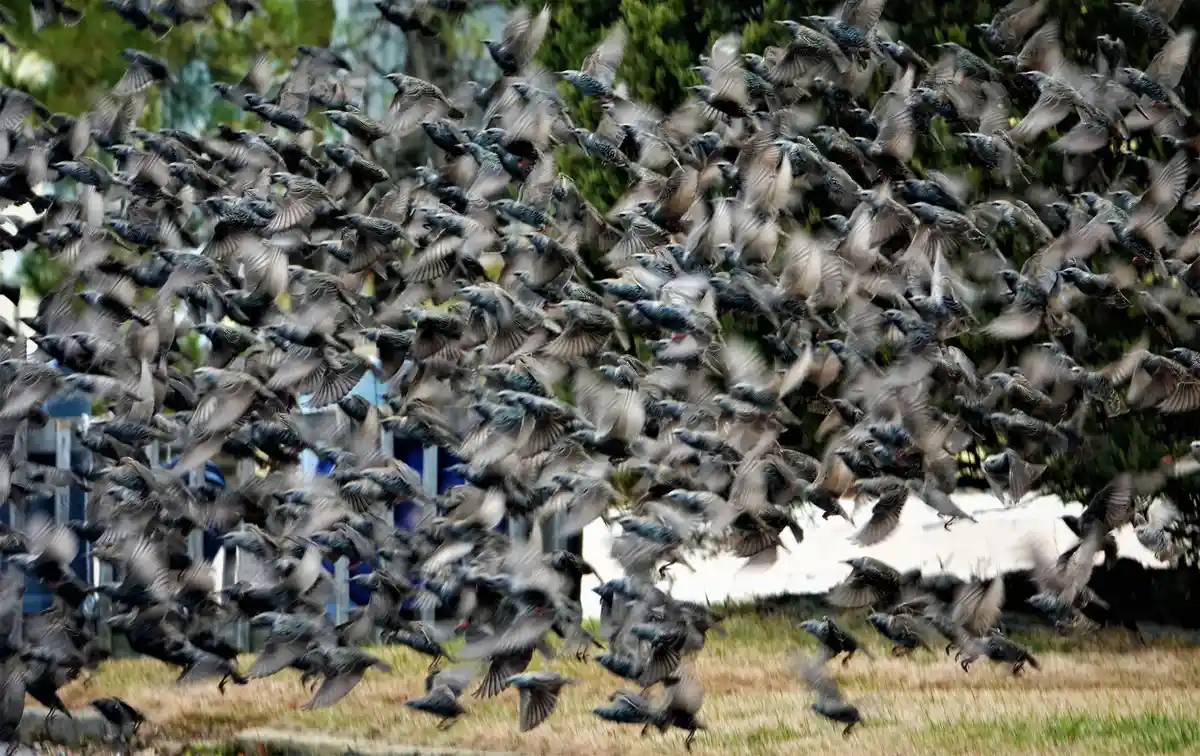
STARLING SATURATION: In N.J., pretty much the only blastable songbird-ish species is the non-indigenous and ecology-mangling European starling. LBI and vicinity have recently been put upon by huge flocks of these crappy (literally) little brutes. They’ve become a flockin’ problem for the entire nation.
In a BBC news story called “The birds of Shakespeare cause US trouble,” writer Jane O’Brien offers, “Thickset and pugnacious, starlings are the bruisers of the avian world.”
Michael Begier, national coordinator for the U.S. Department of Agriculture’s Airports Wildlife Hazards Program calls them lean and mean. “In the industry they’re often called feathered bullets.”
“(Starlings) are a particular problem at airports because they flock in very large numbers, and compared to other birds, their bodies are very dense. They are about 27 percent more dense than a herring gull, which is a much larger bird,” said Begier.
The body densities of the birds, along with cloud-like flock sizes, have literally brought down planes. In 1960, an aircraft taking off from Logan Airport in Boston hit a flock of in-flight starlings. They caused an engine stall leading to the deadliest bird strike crash in U.S. aviation history, killing 62 people on board. The Federal Aviation Administration reports the birds have led to at least one other crash and numerous aborted takeoffs and precautionary landings. Starlings are the number one bird-strike species for aircraft landing at and departing from Atlantic City International Airport.
As to their huntability, short of their being minor thrill-kill targets, starlings aren’t much for the dinner plate. They are not blackbirds, which are decent fare, made immortal when a queenish Anne Boleyn famously ordered servants to run into the fields with pockets full of rye to nab “four and 20 blackbirds” to bake into a pie for the king. Had starlings been baked into the pie, some sort of 100-year spat would surely have ensued.
Starlings can also be dirty birds. According to pestproduct.com, “The European starling transmits five bacterial diseases, including Salmonellosis, fungal diseases, blastonycosis, and histoplasmosis. They also carry the protozoan disease toxoplasmosis and chlamydiosis. Starlings spread fowl pox to poultry, swine gastroenteritis tapeworms and other livestock diseases.”
FROM WHENCE COMETH …: The story behind our Americanized shoot-on-sight starlings is rife with weirdness … with some serious Shakespearean drama thrown in.
To those of you well-versed in the Bard’s rhetoric, you’ll surely recall a line from “Henry IV” in which an effort is made by Hotspur – no, he’s not a sexy Wild West cowboy – to drive King Henry cuckoo by training a European starling, famed for its parrot-ish ability to mimic sounds, to constantly repeat the name “Mortimer,” ad insanitium. Hotspur: “I’ll have a starling shall be taught to speak nothing but ‘Mortimer’” — a rebellious landowner the king refused to ransom out of prison.
Due to its apparent high literary import, the starling became a prime import target of a highly shortsighted group known as the American Acclimatization Society, founded in New York City in 1871. The high-society society was comprised of a cross-section of NYC elite who wanted post-bellum America to flow freely with European flora and fauna. The group’s charter was to introduce “such foreign varieties of the animal and vegetable kingdom as may be useful or interesting.” They were some weird folks.
Even weirder in nature was the society’s chairman, New York pharmacist Eugene Schieffelin, a German immigrant. A fanatical Shakespeare aficionado, he sought specifically to import every bird the Bard had ever mentioned in his combined works, along with some birds Schieffelin suspected Shakespeare might have thought about mentioning. It came to over 60 species. And, first and foremost, starlings would be the star attraction.
According to BBC News, “Choughs, wrens, cormorants, owls, nightingales, larks and some 60 other species all have their place in the playwright’s canon. Such references have inspired bird lovers for centuries. So much so that in 1890 … Schieffelin decided it would be a great idea to introduce as many of Shakespeare’s birds as possible to North America. One cold winter’s day he released 60 starlings into New York’s Central Park in the hope they would start breeding. Unfortunately, they did. The US is now home to an estimated 200 million European starlings.”
Those hundreds of millions now wax poetic and prolifically in both town and country. When going country, they cost U.S. agriculture an estimated $1 billion a year, intentionally focusing on only the finest of farmers’ grain. “What makes the starlings particularly insidious is that they pick out the finest quality grain, which causes a reduction in dairy output because the cows aren’t getting the nutrition they need,” said George Linz, a research wildlife biologist at the USDA National Wildlife Research Center.
As to fighting European starlings on the land and in the air – they’re not big on seas – they have the upper wing. Their willingness to mingle with humanity means no clean shots can be had without spraying a neighbor or two with buckshot. In farmers’ fields, taking them out would mean collaterally destroying protected songbirds – ironically, a serious and befuddling MBTA no-no.
The European starling’s scientific name says it all: Sturnus vulgaris. Even if you don’t know Latin, you get the drift.
OF BASS, BLUES AND DECISIONS: Last Thursday’s meeting of the N.J. Marine Fisheries Council was a big draw, as in turn-away crowds. Public input included over 50 comments, none of which held much sway since the decisions of the council were something of a foregone conclusion. That makes sense since there had been great debate among the decision-makers prior to the evening’s final votes. As commenter Victor H. put it: “When we get here, it’s already over.”
Victor then tried to impress on folks that this meeting was not the proper forum to bring up heretofore unpresented data – and especially no time to suggest entirely new options. He was mainly trying to muster support for an upcoming Mid-Atlantic Council bluefish meeting in Toms River, where data loosing and anecdotal insights might sway national-grade decision making.
Even with the council’s preset mindset, comments flowed forth.
I’ll go big-picture first by noting well-respected recreational and commercial commentators spoke in unwavering terms about indescribably massive schools of blues and stripers having been frequently spotted far out at sea, as in 30 miles or more. One speaker suggested as far as 60 to 80 miles out! First-hand accounts told of striped bass so far out they were hitting trolled tuna rigs – being pulled at big game speeds, no less.
There was agreement that such far-out showings of large bass and an unmeasurable bluefish biomass had never before been seen – or spoken of.
This is where I’ll note that not once was even a hint of climate change entered into the evening’s testimonials. I thought for sure the mention of two fish biomasses opting for unprecedented offshore waters might spur some mention of a suffering atmosphere spurring on the outward movements by these famously nearshore gamefish.
There were numerous folks choosing to blame dredging, mainly beach replenishment, for diverting fish, including forage fish, far from their historic routes. Those suggestions were applauded.
Somewhat inconsistent with the dredge blame ticket was a cadre of speakers instead bringing up the fevered nearshore bass bite seen by boat bassers this past fall. Twice spoken: “I’ve never seen so many big stripers.” One Cape May boat captain said he took four bass over 60 pounds!
BLUEFISH SPOKEN HERE: During a lengthier-than-expected one-hour bluefish comment period, a steady flow of comments focused on the historically cyclical nature of bluefish. A reference was made to the 1930s, when bluefish were virtually unheard of in the region.
The state then showed slides indicating bluefish have long been very overfished, implying that even arriving up times within their cycles couldn’t compensate for decades of drastic overharvesting.
Anger over this year’s draconian bluefish bag limit cuts – from 15 fish down to 3 – was pervasive, even though attendees were again advised that the state’s fishery management council is restricted to voting on only the highly restrictive options sent down from up above, i.e. the Atlantic States Marine Fisheries Commission’s Bluefish Advisory Panel. The council’s voting was limited to options virtually everyone who spoke said were “all bad.”
Final vote: The preferred recreational option was three fish of any size for all but patrons on for-hire vessels, who can keep five bluefish of any size. It passed unanimously.
Some fuss was made over the differentiating of recreational bluefish bag limits, which slightly favored for-hire vessels. There was a fear such bag limit differences could pit recreational anglers against fellow recreational anglers, paving the way for differing recreational and for-hire bag limits for other species.
BASS VOTE: It is highly likely 2020 will see a one-fish bag on bass between 28 and less than 38 inches, per Thursday’s vote by the council. Of significance, some speakers preferred the coastal default option of one fish from 28 inches to less than 35 inches as better fostering a targeted striped bass recovery. Both meet an Atlantic States Marine Fisheries Commission demand for at last an 18 percent reduction in recreational striped bass harvesting.
A common gripe among meeting attendees: Even a world-record bass can no longer be kept in New Jersey.
As to the state’s Striped Bass Bonus Program, a suggestion for creating a “cow tag,” allowing the keeping of bass 38 inches and over, was shot down. It seemed counter to the coastal intent to stop the keeping of the largest bass.
The council instead voted for a bonus bass program of one fish between 24 inches and less than 28 with 27,000 permits available. The starting date for the program was changed from Sept. 1, 2019, to May 15, 2020.
Subscribe to keep reading
This story is from our archive. Get your SandPaper Annual Pass for access to our digital archive, plus everything else a pass includes. Details below.
Annual Pass — $18 Details
365-day access to:
- The complete SandPaper digital archive (stories date back to 2012).
- Full photo galleries from our photographers.
- The entire catalog of SandPaper games, puzzles and quizzes.
How it works
- Enter your email below and click to pay the one-time $18. Card details are entered on Stripe’s secure page.
- You’re in straight away — no password to create, and nothing to set up or manage.
- You stay signed in. If you’re ever signed out, or you read on a new phone or computer, we’ll email you a code to get you back in.
- Never auto-renews. Your pass is good for one year. We will email you when it expires so you can renew if you’d like.
See our site policies for more information.
Already a subscriber? We’ll email a code to get you back in.