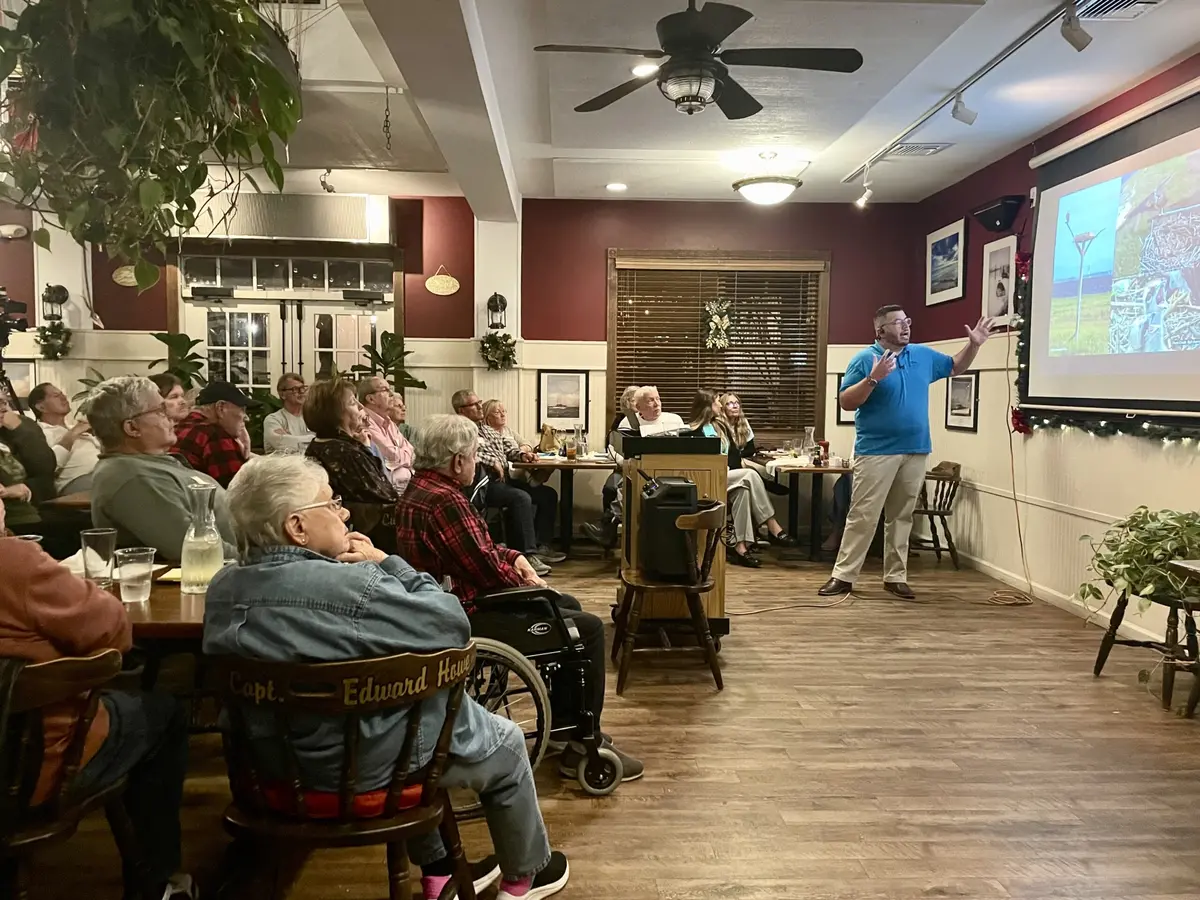
Liam Dorsey, a Forked River native and operations manager at New Logic Marine Science Camp, stopped by Buckalew’s Restaurant and Tavern in Beach Haven last Thursday, Nov. 19, to lead a discussion on the declining Atlantic menhaden population along the coast – and the impact of this decline on ospreys. Along the Jersey Shore and in the Chesapeake Bay, the largest and most critical nursery for menhaden, these birds of prey just experienced their worst nesting season on record.
The evening event at Buckalew’s was organized by New Jersey Maritime Museum President Deborah Whitcraft and Executive Director Jim Vogel, who recognized, as they noted when announcing the presentation, that ospreys “have become such an important part of life here on Long Beach Island.” The room was packed full of residents, many of them members of the museum.
As Vogel said when introducing Dorsey, this “hot-button topic” affects an animal “we all love.”
Dorsey, an avid outdoorsman and graduate of the University of Miami’s Rosenstiel School of Marine and Atmospheric Science, feels ospreys are “one of the coolest birds, if not the coolest bird, in this area. … They’re widely known as what we call an indicator species; they’re very sensitive to the environment.
“Anecdotally,” he continued, “I’m outside all the time, and I haven’t seen many ospreys. This is incredibly concerning.”
This is what happens, said Dorsey, when you remove a “keystone species” like menhaden from the ecosystem: Animals that depend on this species for survival suffer food stress, their populations dwindle, and “the ecosystem collapses.”
Menhaden, known as bunker, are an essential food source for ospreys, as well as for fish such as striped bass and bluefish, and marine mammals, including whales and dolphins. The small, silvery, oily bunker, a forage fish that schools near the surface of the ocean, is harvested in great numbers by industrial reduction fleets to process into fish meal, fish oil and fish solubles. These numbers, according to many recreational fishing and conservation organizations, appear to have gotten too great, but no strong measures have been put in place to force a change of course.
Ben Wurst, senior wildlife biologist for Conserve Wildlife Foundation of New Jersey, attended Dorsey’s talk, as he works closely with ospreys in this area. As Wurst wrote in a recent blog post for CWF, the Atlantic States Marine Fisheries Commission Atlantic Menhaden Management Board met earlier this month to establish the coastwide harvest quota for menhaden for the next two years, and to consider management measures on the Chesapeake Bay. “The bay has long been considered the most productive nursery area for Atlantic menhaden, contributing substantially to the coastwide population,” he said.
“These decisions will help determine how many of these important forage fish remain in the water to support the broader marine ecosystem,” he continued. “Overall, the board voted to reduce the coastwide menhaden harvest by approximately 9% in 2027 and another 9% in 2028. They also voted to enact a more conservative harvest on Chesapeake Bay and link it to the coastwide harvest. These reductions in harvest may sound good for the ecosystem, but in 2025, only 63% of the coastwide quota was actually harvested. In Virginia, the reduction industry harvested 95,000 metric tons. Their new quota is still above what was harvested in 2025, as they typically get around 75% of the coastwide quota. In 2027, that means that their quota, or total allowable catch (TAC), will be around 114,000 metric tons.”
The new TAC for 2026 and 2027 is also 30% above what was recommended by the ASMFC Technical Committee to have a 50% probability of keeping fishing mortality at or below the Ecological Reference Point (ERP) target.
As Wurst noted, “The ERP model does not evaluate osprey breeding performance or localized food stress, although it does recognize ospreys as an ecologically sensitive predator. It specifically incorporates the forage needs of Atlantic striped bass, the focal predator in the assessment, which was a more consistently sensitive predator of menhaden. Basically, when fishing mortality exceeds the level associated with this target, more fish are removed from the ecosystem, leaving fewer available to support predators such as ospreys, whales, striped bass, tuna, seals and other wildlife.”
That wildlife “all depends on this fish to survive,” Dorsey said of menhaden.
Dorsey recounted how ospreys were once greatly affected by DDT use and human disturbance, causing the number of nests in New Jersey to dwindle to about 50 by the early 1970s. Decades of effort, though, begot a comeback for the species, with the number eventually rising to 800 nesting pairs of ospreys in New Jersey.
Now, though, this could be “a success story in reverse,” as the scarcity of menhaden is causing abandoned incubation or starvation of young, he said.
Barnegat Bay, he pointed out, had the worst nesting numbers in the state, with only 0.3 chicks per pair. For the population to maintain its levels, said Dorsey, there needs to be between 0.8 to 1.3 young per pair. The overall state numbers reached just 0.51.
“That’s startling,” Dorsey remarked. “That’s alarming.”
As Wurst pointed out, “We expect food stress among coastal nesting ospreys to continue into next year, and potentially into 2028, unless conditions improve. Dr. Bryan Watts of the Center for Conservation Biology has estimated that, in the Chesapeake Bay, ‘if these (breeding) deficits continue, populations are expected to decline at an average rate of about 10% per year.’
“Here in New Jersey, where the majority of our ospreys nest along the coast and have historically relied on menhaden as a plentiful food resource, continued declines in reproductive success could eventually translate into a considerable decline in the breeding population.”
Dorsey and Wurst agree that more studies on menhaden are needed in this area. They’re also in agreement that residents should reach out to the politicians who represent them. “If you feel passionate about this, call your congressman,” said Dorsey. “Talk about it. Spread the word.
“This industry will try to stifle this to make a buck,” he added.
A man attending the talk asked Dorsey, “Doesn’t it make sense to have a moratorium on menhaden fishing?” to which Dorsey replied, “Yes. That would solve all of this.”
However, Dorsey believes the ASMFC continues to “mismanage” the menhaden fishery, which he says is “America’s most important fishery.” In turn, we will see less of the species that depend on bunker to survive, such as ospreys.
Another attendee said that earlier this year she had seen a number of ospreys on their nests at the Edwin B. Forsythe National Wildlife Refuge along Wildlife Drive in Oceanville. Wurst, though, said that while all eight nests there were active and 19 chicks hatched, only one single young bird survived to fledge. “Observers remarked seeing adults absent from nests that had young,” he explained. “Those young later died, most likely due to starvation.”
As he noted later, “Survival of fledglings is an unknown, and with current food stress, survival is even more challenging. … We are considering tracking adults and possibly a few fledglings next year to learn more about foraging behavior and survival of fledglings.”
According to Wurst, “Ospreys are long-lived birds that may continue to occupy territories for several years even when they are not reproducing at a level to sustain the population. Reproductive productivity, measured by the number of young produced per active nest, is a much more meaningful indicator of population health. We should not assume that our osprey population is stable simply because the number of nesting pairs remains high.
“Ospreys are highly visible, fish-dependent predators and valuable bioindicators of the health of our coastal ecosystems,” he added. “Right now, their reproductive success is providing an early warning of problems within the marine food web. Ensuring the availability of adequate forage fish is an important management objective if we want to protect the long-term future of New Jersey’s ospreys.”