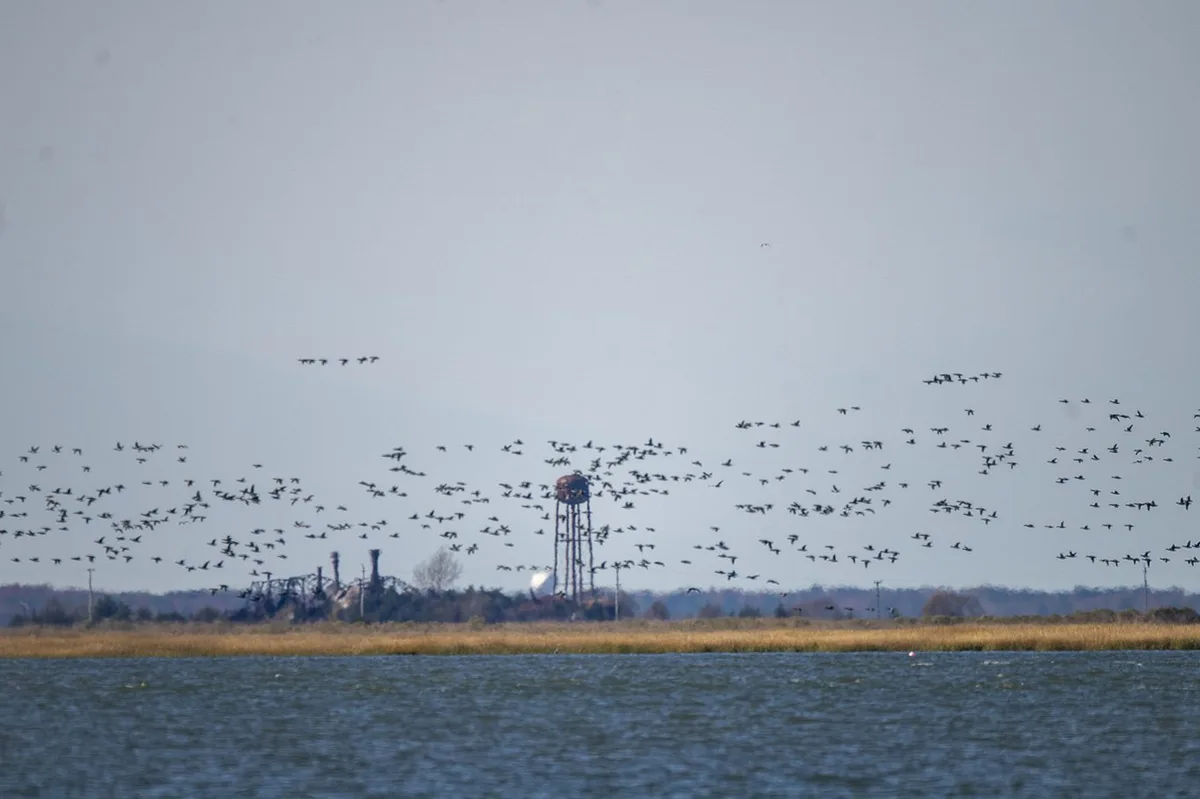
As the holiday season envelops the LBI region, birdwatchers will don their warm winter apparel and binoculars and head outside on a mission to count the birds that live here during the coldest months of the year.
The massive international bird census known as the Christmas Bird Count is a historic community-science project powered by volunteers. The effort connects local observations to a historical record scientists use to study changes in bird populations and the environments they inhabit.
Between Dec. 14 and Jan. 5, bird enthusiasts submit feeder counts and field counts, providing to the Audubon Society an invaluable snapshot of bird populations across the Western hemisphere. Numbers are collected from across the U.S., Canada, Latin America, the Caribbean and the Pacific Islands. Participation is free and open to birders of all levels of skill and experience.
Feeder counts are tallied by noting all the birds seen or heard from a participant’s own backyard (or local park at a stationary bird feeder within a designated 15-mile CBC circle). The advantages, of course, are less of a time commitment and no special equipment or gear required. Field counts are tallied by surveying an area (alone or in groups) during daylight hours and recording all the birds observed. Some counts also include after-dark surveys to record owls and other night-active species. Counting groups are assigned to specific areas or bird feeders within the circle boundaries. Every bird counted contributes to the greater understanding of how bird populations are changing and what actions are needed to protect them, according to Audubon. CBC data drives real-world conservation action and policy decisions.
American ornithologist Frank Chapman originated the event on Christmas Day in 1900 as a humane alternative to the holiday bloodbath known as the “Side Hunt,” a competition to shoot the most birds and small mammals. In its first year, 27 birders recorded 90 species. Today, more than 85,000 birders participate each year, proving “the power of community can change the course of conservation.”
For Ocean County Parks and Recreation Department park naturalist Josh Gant, the event is pivotal from multiple perspectives.
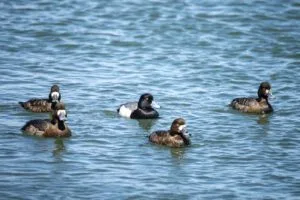
Greater Scaup Ducks in Barnegat Inlet.
“The time spent with good friends doing what we love is really the most rewarding part,” he said.
“This census has been going on for 126 years. Atlantic Audubon Society has been running the same circle for 51 years. SOBG has been running its circle for about 16 years. Keeping an eye on changes in birdlife in an area is very important. I do find the data collection part rewarding, as well. The information we collect can be used to help put numbers behind groups trying to enact environmental change.”
Gant is an environmental educator, a birding and sightseeing boat tour guide out of the Tuckerton Seaport, president of the Atlantic Audubon Society and vice president of the Southern Ocean Birding Group.
Of its 70 total members, 25 to 30 are involved in the Christmas Count each year, according to Gant.
In his role as president of the Atlantic society chapter, Gant runs the Marmora Christmas Bird Count Circle, he explained. He has run the event for about five years and participated for about nine.
“I try to do four to five a season,” he said.
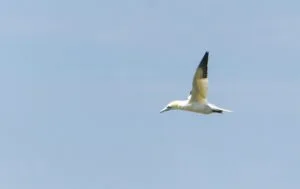
Northern Gannet in flight
He predicts the most common species “by far” in this year’s count will be American herring gull and brant. Holgate will usually have a flock of 2,000 to 3,000 brant over the winter, he said. Next most common will be “probably American robin, if the flocks are roving around.
“In the bays, huge numbers of scaups, two similar species of ducks, will be seen. Usually, one team spends the day sea watching, and they will see over 1,000 Northern gannet flying south over the ocean.”
The rarest bird Gant has seen during a Christmas Bird Count is “probably a sharp-tailed sandpiper, a shorebird from Asia mixed up with a flock of dunlin on a beach on Stone Harbor.” But the rarest bird in his personally observed collection is “a western kingbird that showed up in a cemetery in Marmora,” he said.
“Every birder has high hopes of finding rarities; the ‘Holy Grail’ would be something like a yellow rail or black rail, or possibly a vagrant species from Europe or Asia. A northern wheatear would be a really good ‘Holy Grail’ bird.”
Gant also runs trips during the spring and fall festivals for New Jersey Audubon (no relation to Atlantic Audubon Society); is a local reviewer for eBird, verifying rare and unusual sightings in Ocean and Atlantic counties; and works part time for Eagle-Eye Tours doing mostly domestic birding and nature trips.
To his Tuckerton tour groups, he points out different species in different seasons, as well as points of interest along Tuckerton Creek, he explained.
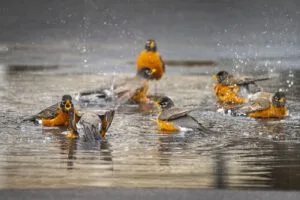
American Robins taking a bath.
“I usually point out the osprey nesting platform in the marsh, and the roost of black-crowned night herons that can be found along the creek most of the year,” he said.
His preferred birding locations are “deeper in the woods,” he said, “on old sand roads. Either that or on a coast with a view of the water.”
But the circles of the CBCs are cut into sectors, he explained. “We bird in the areas we are given. Usually, the same groups get the same area, to keep the birding style and numbers consistent.
“The sectors I give myself tend to have a mix of habitats, open water bays, deep woods and developments. That spices up the birdlife we see. We also go owling in the morning.”
For 126 years, the count’s annual summaries have been reported in publications from Bird-Lore (the original CBC publication) to Audubon Field Notes, American Birds, and now are available online to everyone at audubon.org/community-science/christmas-bird-count/join-christmas-bird-count.
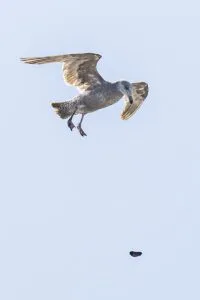
An immature Herring Gull dropping a shellfish in order to break open the salty treat.
The CBC data detects population trends and documents geographic distributions that provide early evidence of climate change impacts. The data is also used by government, nonprofit and community agencies as an important basis for making decisions about bird conservation and management.
For a full program overview, detailed counting protocols and volunteer roles, see the Christmas Bird Count Guide.
“Usually about a month or two before the count season begins, the emails get sent out to the members. Some count leaders have Zoom meetings or in-person meetings to discuss changes to the count, if there are any. We also have a meeting after, where we tally the whole day’s findings. Usually, most record keeping is done online today using eBird. A single checklist can be sent to everyone, and they just have to submit data there to tally everyone’s lists.”
To protect themselves in the cold, hardy wintertime, birders might utilize electric socks and hand and foot warmers, or merino wool blend socks in insulated boots, strategic layering – insulated coveralls or long-johns, flannel, down jacket, windbreaker, even wind breaker pants – and take frequent hot tea and coffee breaks.
“As we say, there is no bad weather, just bad clothing,” Gant said.